


For a genre that is inherently maximalist, there’s something beautiful about a good piece of low-fi horror. Movies that can bend the very confines of the medium to their will are often cemented as classics, finding simple ways to tell scary stories. And while Ian Tuason’s undertone promises to do for sound design what The Blair Witch Project did for found footage (“The scariest movie you’ll ever hear”), the result is a film that fails to innovate beyond some of the genre’s most familiar tropes.
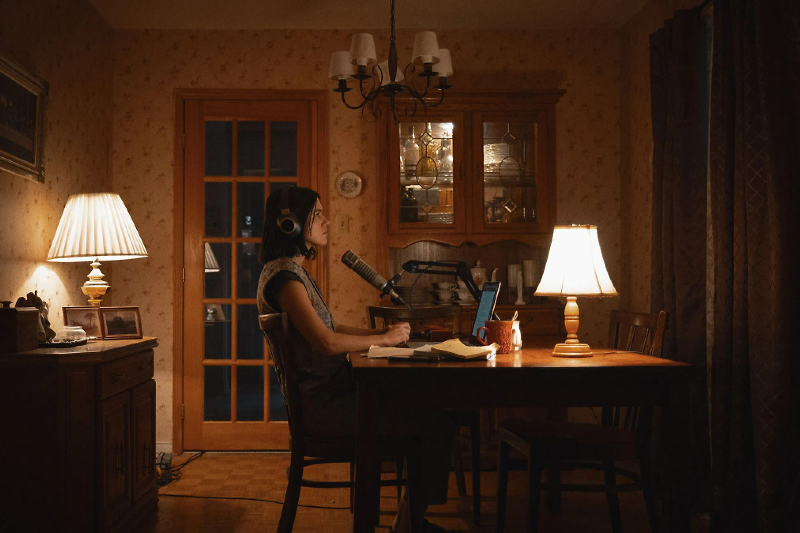
Since moving back to her childhood home to provide palliative care for her mother, things have gotten really, really bad for Evy (Nina Kiri). She’s on the rocks with her boyfriend and drinking again; pretty much the only thing she has going for her is the paranormal podcast she runs with Justin (Adam DiMarco), a longtime friend. So to take her mind off things, Justin proposes a special episode of the podcast, where Evy and Justin listen to a series of ten audio files sent to them by a mysterious listener. As the tapes progress, they listen to a couple whose attempts to document sleep talking turn into something darker.
In a more conventional version of this film, Evy would enlist the help of an online expert to understand the hidden messages in the tapes. Instead, Evy has search engines. Much of Evy’s research is conducted online, digging through Wikipedia pages and public websites to learn more about the medieval folk songs the couple sings in their sleep. We are treated to crowdsourced primers on European lore and demonic possessions, which Evy – betraying her performance as the duo’s on-air skeptic – seems to accept at face value.
(We must be mere months away from a film where the main character asks Chat GPT to research the monster for them. Horror protagonists, never gifted with an abundance of self-preservation, are about to get a whole lot dumber.)
But the deeper Evy goes into the recordings, the more she begins to sleepwalk through her own life. Her mother lingers on, and Evy starts noticing things out of place in their home. Lights go on seemingly at random; bulbs begin to flicker with surplus energy. And when Evy begins to grapple with the fallout of her personal life, she soon learns that the lines between heaven and earth are far less worrying than the lines between earth and hell. Maybe listening to all ten tapes is, in fact, a terrible idea.
Despite the early promise of the film's premise, undertone quickly struggles to overcome its threadbare narrative and loosely defined protagonist. For his part, writer-director Tuason seems to draw his inspiration directly from the mumblecore movement of the early 2000s. That’s a fun idea in theory. While mumblecore was born out of creative opposition to studio films, undertone seems to borrow these aesthetics without an original perspective on the genre. We are treated to one woman’s rapid deterioration while the conditions that would shape her personal hell – her relationship with her mother, or her boyfriend, or even her cohost – remain maddeningly opaque.
Restraint can be a powerful creative choice, but only if the audience believes in the power of what is not being said (or shown). In the case of undertone, it’s hard to imagine any narrative depth beyond the small pieces that made it to the screen.
And the film’s sound design, while impressive, is not capable of elevating what is left. The first time we see Evy put on her headphones, the sound of the world falls away from us as the noise-cancelling effect comes into play. It’s a familiar gimmick, but one so well-suited to undertone’s strengths that we spend most of the movie waiting for Tuason to lean into these contrasting soundscapes. Instead, undertone retreats to a more familiar bag of tricks, choosing creepy voices and backwards music over more innovative effects. Despite a few powerful sequences in the film’s climax, the failure of undertone to progress its auditory scares is one of the film's biggest frustrations.
In fact, what’s most maddening about undertone is how close it comes to offering something unique. Fans of films like Session 9 and Pontypool know how well found audio can be used to parallel a personal breakdown. But those movies demonstrated a remarkable ability to bring together sound and production design to propel audiences forwards. Had undertone set its sights lower – a little less arthouse, a little more creepypasta or true crime – there could have been a better balance between characterization and innovation. Instead, Tuason seems content to drift between recording sessions.
Even after tallying up the film’s audio tricks, undertone is five pounds of movie in a twenty pound bag. Perhaps Tuason has crafted the rare film to benefit from a smaller screen; it’s certainly possible that the spatial sound design in undertone could play best when heard through earbuds or a pair of noise-cancelling headphones. Like screenlife movies, undertone may be a film that embraces the digital experience above all. But while it will no doubt find its audience among fans of lo-fi cinema, undertone is just further proof that a few wrong notes are much preferable to a bland melody. [2/5]