



It doesn’t take a genius to understand why, in a world beset upon by capitalism and existential unease, narratives of urban liminal spaces have taken the internet by storm. Online communities are full of collective creepypasta or viral galleries of urban exploration, priming the pump for some visionary young filmmaker to come along and cash in onscreen. And while the jury might still be out on director Kane Parsons being a visionary, the media surrounding his debut feature Backrooms certainly confirms that he’s young – and about to cash in.
But is Backrooms the kind of generational shift reserved for titles like The Blair Witch Project? Or is Parsons stuffing two pounds of substance into a ten-pound bag? While there’s a lot to like about his liminal horror debut, ultimately, Backrooms is an exercise in diminishing returns – not unlike the eerie spaces he helped craft onscreen.
Even since his wife left him, Clark (Chiwetel Ejiofor) is in search of his reason for being. It’s not his furniture store; despite repeated attempts to promote his closeout sales to the broader San Jose community, Clark is left in an enormous warehouse with plenty of inventory and not a customer to show for it. So when Clark tries to investigate the source of a broken fuse box, he is shocked to find himself in a seemingly infinite office building located beneath his store.
Stay in touch
Sign up for our free newsletter
At first, Clark is skeptical. But the more he explores (and maps) the boundaries of the back rooms, the more he comes to believe it is a twisted variation on our real-world buildings. This is also what he tries to explain to Dr. Kline (Renate Reinsve), the pseudo-celebrity therapist who guides him through his own divorce. When Dr. Kline decides to check on Clark’s delusions for herself, she soon comes to realize that his frantic stories of enormous rooms and melted furniture are nowhere as fantastical as they seem.
You don't have to look very hard to see the big ideas that Parsons and screenwriter Will Soodik have in mind for Clark. When confronted with a funhouse mirror version of his own life, Clark chooses the comfort of artifice and the grotesque rather than change (as the saying goes, men would rather explore unknown time-space than go to therapy). Thematically, that’s red meat for anyone who feels like we live in an alienated world. But as Clark himself says, the devil is in the details, and Parsons seems uncertain of how to let those big ideas really sink in. Ejiofor, one of the great actors of his generation, is left to swing wildly between fear and rage with nothing more than cursory gestures towards an inner life.
The same can be said for Dr. Kline, whose own trauma – a childhood spent trapped in the shadow of an agoraphobic mother – is also meant to color the connection between space and memory. Reinsve is never given enough emotional scaffolding to create something narratively load-bearing. She wanders through her life, vaguely unsettled, and takes it upon herself to rescue Clark without the film ever really developing their relationship. When the film eventually trades in its brand of urban exploration for indie horror game mechanics, Reinsve proves herself a kind of capable, cosmic final girl, but by then the movie has revealed its cards – and shown us that most of the ones we were counting on are blank.
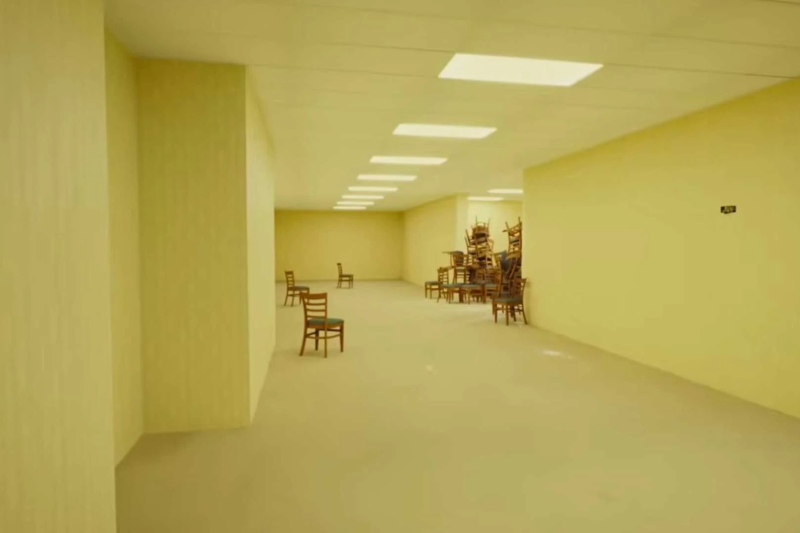
How much mileage can you squeeze out of a film’s staging? That’s the good news: when your sets are this good, you can skate along a lot longer than you might think. Parsons may be the one getting the industry writeups, but the true breakout star of Backrooms has to be production designer Danny Vermette, who blends faded ‘80s office space with Cubist absurdity. The film lives and dies by the slow rippling of stylization found on the other side, where rooms and characters become more abstracted the farther removed we are from the real world. It’s not enough to make us care about the characters, but Backrooms does evoke experiential set design from productions like Meow Wolf or Sleep No More. That’s undeniably cool.
Still. One can’t help but wish Parsons had been willing to embrace his film’s own untapped potential. No 20-year-old director would look down their nose at a Christopher Nolan comparison, but Backrooms feels like a halfhearted attempt at Lynchian cinema in much the same way that Nolan’s Inception traded the absurdity of dreams for superhero-adjacent game mechanics. No matter how good your set might be, you can only showcase an array of images so often before your audience gets immune to their impact. Without the beating heart of a weirdo to drive it, the twisted milieu of Backrooms eventually gives way to diminishing returns.
There's no denying that the film's early commercial and critical response makes Backrooms an unmitigated success, and Parsons has – barring some kind of personal disaster – cemented himself as one of Hollywood youngest and brightest stars. The fact that his debut feature is more an exercise in aesthetics than a grappling with the human condition certainly doesn’t take away from that. Backrooms may ring hollow for all the wrong reasons, but its emptiness is subjective – those who project their own disillusionment on Parsons’s hallways and corridors may be more than willing to meet the director halfway. Just make sure you tether yourself to something resembling emotions, because Backrooms itself proves how easy it is to get lost when trying to do something singular. [2.5/5]