


While he’s nobody’s idea of a household name, horror fans love them some André Øvredal. After the critical success of Trollhunter and The Autopsy of Jane Doe, the Norwegian director continues to flirt with the mainstream, tackling bigger studio projects like Scary Stories To Tell in the Dark and The Last Voyage of the Demeter. And while his latest film might not earn him a spot in the inner circle of Hollywood horror filmmakers, it still proves that he’s one of the industry’s most reliable directors-for-hire. He may not make a movie on his own, but he sure as hell isn’t going to be the one to break it.
After spending years being run ragged in New York City, Tyler (Jacob Scipio) and Maddie (Lou Llobell) are finally ready for something different. Seeking answers online, Tyler becomes obsessed with the vanlife community, a group of influencers and content creators who have turned their back on static communities in favor of the open road. So after quitting their job and putting their life savings into a brand new RV, Tyler and Maddie decide to embark on their own grand adventure.
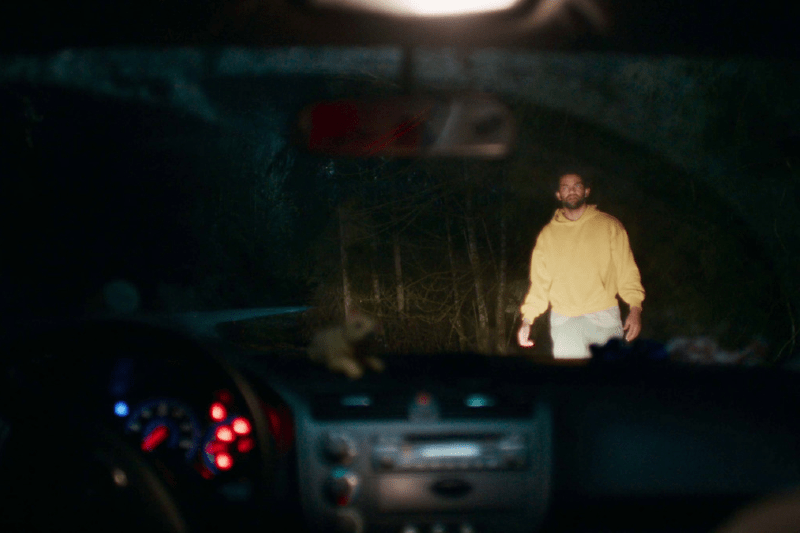
At first, van life is everything they hoped it would be, filled with nonstop adventures and a supportive community. But there are rules to living on the road, rules that have been passed down from generation to generation from the darkest backroads of American highways. And when Maddie convinces Tyler to stop and help a car in distress, they accidentally break the most sacred rule of the road: never stop, especially far away from civilization, because you never know what might climb aboard when you’re not looking.
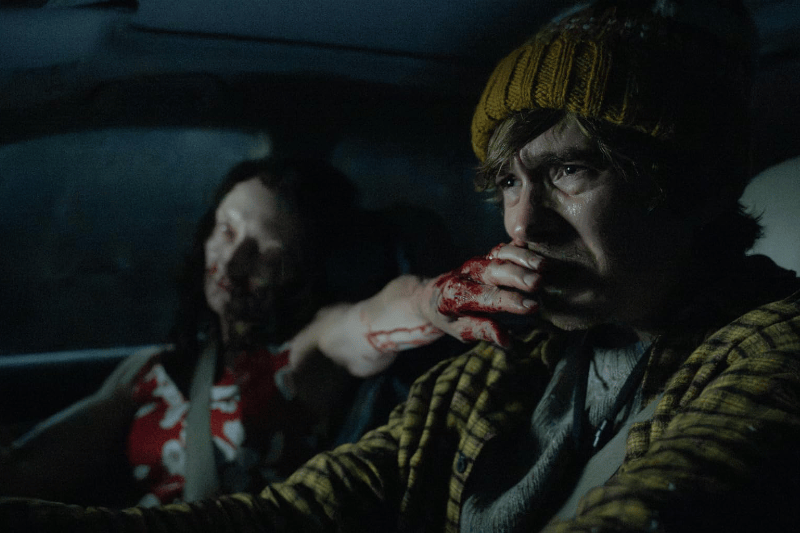
And there you have it: a haunted house movie on wheels. Maddie desperately tries to convince herself that there is an evil spirit in the van, while Tyler does his best to make their new life work despite the stress. Familiar? Yes. But Passenger also nibbles just enough around the edges of a compelling story to keep things from going off the road.
The idea to marry vanlife culture with ghost stories from 1950s Americana is admittedly pretty smart. Passenger may not have a ton of lore in its back pocket, but there’s enough connective thread between post-war expansion and modern downsizing trends to make the film feel like it has sharp teeth despite its very conventional execution. Throw in a healthy dollop of religious horror – St. Christopher as beset upon by real-world demons — and screenwriters Zachary Donohue and T.W. Burgess give Passenger just enough weight to justify taking a closer look.
And what do we see? Well, some modern horror is marketed as the work of a visionary new writer-director. Some horror is a showcase for a recognizable Hollywood actor looking to establish themselves outside of the franchises that made them popular. This film is neither. There’s something charmingly old school about Passenger, which combines a yeoman director, an eight-figure budget, and a pair of anonymous leads. It’s the kind of cocktail that would’ve seemed commonplace in the 1990s but feels downright anachronistic in 2026.
Like many studio creature features, much of what makes the film work is tied to Øvredal’s role as director. In the prehistoric days of film criticism, entire books – or at least very lengthy magazine articles – would be written about the sequences in films where a filmmaker flashed their personal style. Passenger is a throwback to those classic studio films, in that Øvredal provides a thoroughly competent horror exercise with a few pops of something more.
Nowhere is this more present than in the film’s middle sequence, where Tyler sets up a projector for an outdoor screening of Roman Holiday. You can decide for yourself if a pair of twentysomethings would be obsessed with a 70-year-old black-and-white feature, but the interplay of projection and darkness allows Øvredal to offer up some old school scares with a mixed media twist.
Once the creature begins to push its way through the outdoor screen, Maddie turns the projector into a camera, bathing the woods in fractured light shows of Audrey Hepburn and Gregory Peck. It’s a dynamic set piece, one that builds on a familiar scene – campers poking their flashlights at the surrounding darkness – and turns into a stylized throwback to vintage Hollywood.
And as the film builds to its showdown – the influenced versus the unholy – Øvredal breathes life into the familiar. Tyler and Maddie are smarter than the average horror lead,s seeking answers from their vanlife community and forcing a final confrontation with their demonic hitchhiker in the middle of nowhere. Not every sequence reinvents the scare, but there are a few visuals (such as a field full of bodies) that work to justify the movie’s existence, and the entire film feels like a horror title that does not assume – for better and worse – that its audience has seen a lot of scary movies to begin with.
It’s the right approach. For the most part, Passenger is competent studio fare, running through the paces of a yesteryear creature feature without talking down to its audience. But every now and again – often when you’re just about to give up on the movie rising above its simple execution – Øvredal will pop in with a visual or a death scene that keeps us engaged. Passenger may not be his most elevated work, but its haunted-house-on-wheels premise and above average execution means that it’s not a movie we can easily dismiss, either. [3/5]