

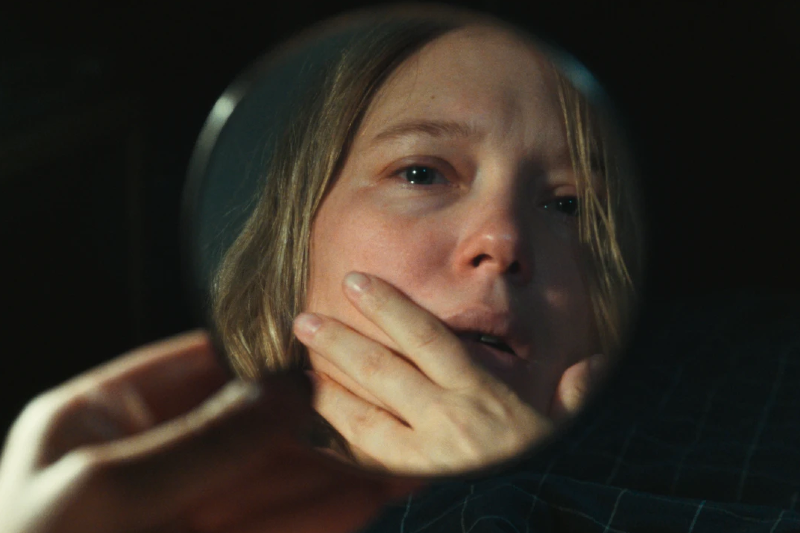


From director Arthur Harrari — co-writer of Anatomy of a Fall — the dread-inducing Cannes competition entry The Unknown (or L'Inconnue) is a body-swap thriller like you’ve never seen. Bucking the genre’s most extreme conventions in the realm of both horror and comedy, the film bides its time. An intense, deeply disquieting psychological study, its drama concerns the sensations of feeling unmoored and outside of yourself, in a manner so specific that perhaps it could’ve only been achieved in this particular, peculiar form.
Partially based on the graphic novel The Case of David Zimmerman (Le cas David Zimmerman), which Harari wrote with his brother Lucas, the movie follows David (an unrecognizable Niels Schneider), a reclusive, troubled, scraggly Parisian photographer embarking on a unique artistic journey. Re-creating photos his father staged nearly 50 years ago — themselves re-creations of century-old postcards — David’s project is one of transposition, as he captures familiar locales whose details have shifted in uncanny ways. This portends the strange magical realism that forms the movie’s premise. At a rave one evening, David is approached by a mysterious woman, Eva (Léa Seydoux), who promptly and wordlessly has sexual intercourse with him in a backroom, only for the film to apparently switch points of view. After the encounter, it follows Eva stumbling back home, only she enters David’s apartment and follows the routine we’ve briefly glimpsed, down to punching in his door code.
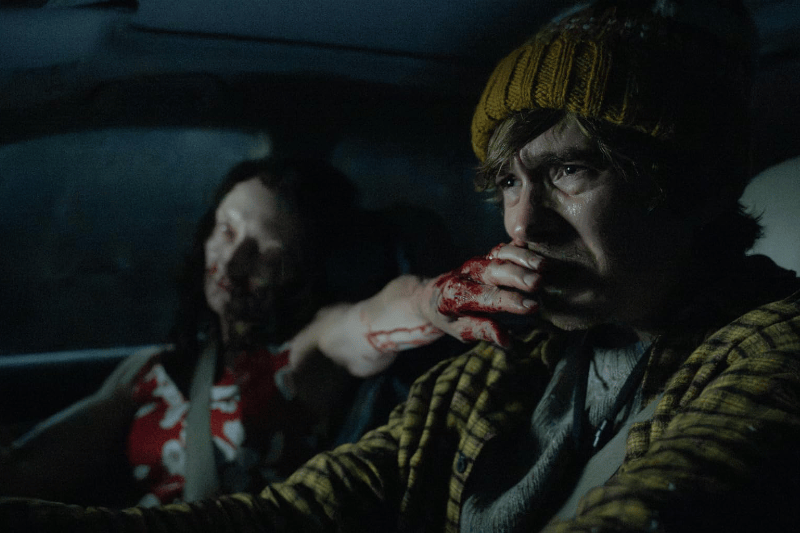
No one proclaims the premise out loud, but Harrari’s unnerving filmmaking and Seydoux’s confused and untethered performance tell us all we need to know about what’s going on. Somehow, David has ended up in Eva’s body, and has been left to solve the mystery for the two of them, as the only one with access to both their apartments; since he wears Eva’s clothes, he has her housekeys as well, and puts her address together after some sleuthing. And, unlike most films of its ilk, the body-swapped protagonist doesn’t bother trying to convince anyone else of what’s transpired. The few people in his life (his friends and his mother) aren’t liable to believe him, but he approaches them in Eva’s visage, to try and find out where “he” (which is to say, his body) might be, if Eva has in turn wandered off as “him.”
To make things even stranger, David, while poring through his old negatives for some kind of clue, learns that he may have photographed the real Eva several months ago, in a moment of public embarrassment. This discovery imbues their physical switch with potentially fable-like significance — or rather, a way for David to make sense of it all through some kind of moral logic. However, it isn’t long before each of these existential questions is gradually nullified, resulting in a premise born of nihilistic cosmic chaos. The fewer concrete answers there are, the further the myriad possibilities stretch. Beyond a point, though, what’s actually happening (or why) ceases to be nearly as important as how it forces David (and a surprising secondary character) to view their own existence.
The traditional mischief of the body-swap movie is, for the most part, absent from The Unknown. The sense of shock is followed by quiet despair, rather than desperate flailing. This is because the story sees David being forced to view himself through other people’s eyes, which happens not only in the absence of his physical body — as Eva, he talks briefly to his loved ones, who express their concerns about his reliability behind his back — but it also comes full circle once our protagonist begins tracing the steps of whoever possesses his physical form.
Once David is finally in “his” own vicinity, Harrari’s otherwise steady camera becomes unmoored and uneven, a dizzying formal flourish that accompanies each gut-churning reveal, as the mysterious nature of this magical metamorphosis fades into view. It is, on one hand, not unlike a bizarre cross between It Follows and Freaky Friday. But on the other hand, its mechanics and mythology remain largely obscured, except for the chilling hints at how widespread this web of soul-swapping might actually be.
This forces David to take to the internet to find others like him, which turns up some particularly morose stories that, in turn, afford Schneider and Seydoux the chance to dig deeper into their own discomfort. Neither actor limits themselves to playing the outward appearance of another gender (though seeing them modulate their body language is the closest the movie comes to having fun). Instead, they probe ever inward, focusing on how this transmutation of physical form would unravel their characters emotionally.
All the while, the movie plays out with scant dialogue and surprising restraint, forcing us to lean forward and intuit its most troubling twists and turns. It’s a mood piece steeped in the kind of dissociation one might frequently hear or read about, but the kind that’s so ephemeral and abstract that it can be difficult to dramatize — that is, until Harari does here. While it appears to be a simple cinematic solution to the problem of effectively visualizing an out-of-body experience, the film’s complexities are born from its genre specificities, its lingering dysphoria, and the idea that sex and one-night-stands, while alluring in concept, can leave you feeling hollow as well, if the circumstances don’t feel right, even for reasons you can’t quite explain. Emotional and physical intimacy should feel comfortable, but when they don’t, something in the pit of your stomach becomes a prism, splitting and scattering your very being.
Few of these are things you can put into words. However, Harrari’s aesthetic control ensures that they each have meaningful pictorial depictions, within a riveting story whose winding path remains shockingly unpredictable, despite the movie’s gradual, intentional unspooling. Across its nearly 140 minutes, there’s seldom a moment you won’t feel wrapt by unease, and by a heavy, lingering sorrow, as The Unknown gets beneath your skin. [4.5/5]
The Unknown is currently playing as part of the Cannes Film Festival. Visit the festival website for more information.