

The zombie genre has long been home to biting societal critique and commentary. From Night of the Living Dead to 28 Years Later: The Bone Temple, most horror fans have ingested their fair share of stories from the land of the undead. Over time, the genre has proven a fantastic vehicle to explore concepts ranging from post-war trauma to general societal stagnation. And no other zombie auteur has done it quite like George Romero, whose first three entries in the Dead series are widely regarded as the most influential zombie movies ever made. But I’m not here to talk about those films. I’m here to preach the gospel of the fourth entry, Land of the Dead, Romero’s eerily prescient look into our modern times.
Set years after the zombie apocalypse, Land presents us with a world that, on the surface, appears stable and grounded — a new society built upon the ashes of what came before. There’s electricity and an economy and things seem fine — people have jobs. It’s almost normal, save for the undead “stenches” that eternally shuffle just beyond the heavily gated community. But in fairness to them, the zombies don’t appear to have much of an impact on daily life. The well-protected city is, for all intents and purposes, safe. And the towering stronghold at its center — the ultra-exclusive Trump Tower-esque Fiddler’s Green — is the safest place of all (if you’re able to get in). At a glance, it’s idyllic, a little patch of normalcy at the end of the world.
But what kind of life is it? For the scavengers sent out in search of supplies, it’s pretty crappy. In fact, when we meet Riley (Simon Baker) and Cholo (John Leguizamo), first and second in command, they’re both planning to leave the game, albeit for very different reasons. Riley is a morose guy worn down by his own survival. He sees the city and Fiddler’s Green as a trap — a lie upheld by corruption — and seeks to distance himself from it. Cholo, on the other hand, feels the exact opposite, wanting nothing more than to be among the upper class, safe and protected in his grandly appointed suite. Both view their selected routes as the only way out, but both plans are hindered by the big man in charge, Mr. Kaufman (Dennis Hopper).
Kaufman doesn’t want Riley to leave because his dangerous labor is integral to the survival of the city and the status quo. He doesn’t want Cholo’s life to improve for similar reasons, but also because, unsurprisingly, the wealthy self-appointed king of Fiddler’s Green hoards status as well as resources. Letting an undesirable into his exclusive club would be the end of his world. His only choice is to sabotage both men in a desperate bid to maintain his stranglehold on the city he claims ownership over despite adding no real value to.
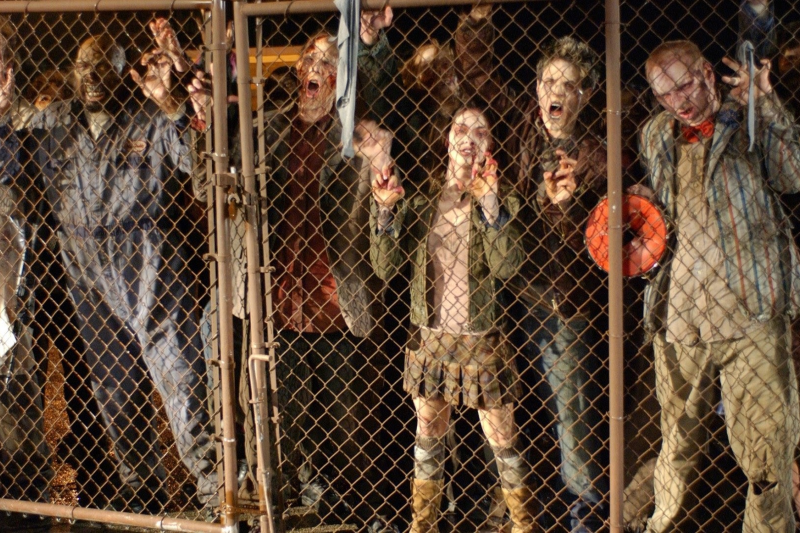
While all this is happening in the world of the living, the zombies are dealing with an awakening of their own — they’re starting to remember. Big Daddy (Eugene Clark), the zombie that runs the service station, goes through the motions of his past life. When the bell dings, he shambles out, ready to fill up someone’s tank. He and the other zombies grasp onto hollow echoes of an existence they once inhabited, now reduced to simple mimicry. They seem content enough in their play-acting – that is, until the men from the city show up to loot.
While a guy like Riley is happy to distract the dead with “sky flowers” (fireworks), Cholo and company prefer to inflict maximum damage, mowing down the distracted zombies as they stare at the sky like mesmerized children. Big Daddy watches in horror as his brethren are struck down. He tries to save them, but they simply don’t grasp the threat — at least not yet.
Romero is very deliberate in his muddying of the waters in Land of the Dead. As viewers, we’re aware we should be rooting for the scrappy, living survivors — they’re us, after all. But aside from Riley and the mostly unseen underclass, the story provides no reason to align with the city folk, especially the gun-toting mercenaries working for Kaufman. In contrast, we have every reason to root for Big Daddy, a dead man just trying to figure out his afterlife; a working-class hero risking it all to save his friends from annihilation. When Riley and his team first roll into town, they’re struck by the strangeness of the zombie’s pantomiming theatrics. But Riley himself is quick to acknowledge the two groups have more in common than they think, stating matter-of-factly, “Isn’t that what we’re doing? Pretending to be alive?”
It’s why Riley wants to leave, and Cholo wants to move up, and Big Daddy wants to pump gas — to live. To make autonomous choices not dictated by outside forces that claim sovereignty over their existence. Because at the end of the world, it’s not death itself dictating the machinations of their lives but a rich old white guy living in a tower.
While Kaufman spends most of the runtime as an offscreen threat, his presence looms large. His name is spoken in whispers, and his only power comes from fear. Standing in stark contrast to Kaufman is the paternal Big Daddy, who not only shows compassion but also displays clear activated intention by picking up a gun and leading his people to freedom. Never is this clearer than when the group gathers at the shoreline, Fiddler’s Green illuminated in the distance. Big Daddy takes a leap of faith, plunging into the water. The rest of the horde follows, emerging on the other side, their vengeance palpable. During their journey to the gated city, Big Daddy becomes something of a Jesus figure, eagerly leading the undead to their destiny, and the fall of Kaufman’s oppressive empire.
Fiddler’s Green, a cadaverous monument to capitalism, is quick to fall. Once the zombies start using tools, the end becomes inevitable, and as the undead crash through the tower’s unsecured windows, Kaufman’s fears are realized: the riffraff really does ruin his cushy existence. Inevitbaly, Big Daddy (with help from the newly dead Cholo) blows Kaufman to bits, putting an unceremonious end to a man whose only concerns were money and power – even during the zombie apocalypse. It’s comforting, though, that he dies like a coward, alone and abandoned, grasping on to long-dead systems of control.
In the end, Big Daddy and the zombies show more comradery than the living. They exhibit a loyalty and allegiance long forgotten by the survivors, or at least the ones in charge. Unlike the ego-driven Kaufman, Big Daddy cares for his brethren, trying to save them — working to build something better. He’s the leader Kaufman should’ve been, activated by the subjugation of his people and driven by the righteousness of memory. Despite the bleak commentary, Land of the Dead ends with hope: the poor are primed to take back the city, Riley is free to head North, and Big Daddy’s zombie brigade marches on. Loosening the reigns and letting people, alive or dead, simply exist is the happiest ending one could hope for.
Like history books, zombie movies offer both a look back and a look forward, their familiar repetition reminding us that even though we’ve gotten far, we’re still shambling toward the inevitable. But like history, we can learn from the Land of the Dead zombies and their rejection of a tyrannical king figure. Even after losing some of their most precious pieces, they’re still able to remember. To organize. To fight. Even at the end of their world, they aren’t content to stay dead. We shouldn’t be either.