



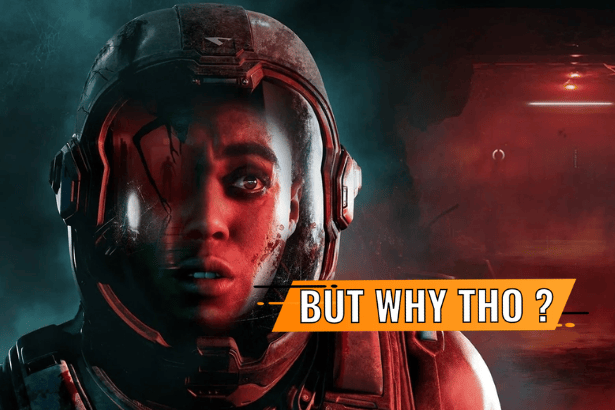
In a world where Mr. Beast has become the face of a media empire, it’s not surprising that Hollywood views YouTube as a shortcut to prefabricated audiences. Then again, ignore the content creators at your own peril: with people like Curry Barker and Chris Stuckmann amassing new audiences as horror filmmakers, YouTube has become this generation’s answer to Super 8, the technology that launched a generation of self-taught directors. But even compared to films like Shelby Oaks or Obsession, Iron Lung – the debut feature from Mark Fischbach aka Markiplier – is one goddamned bold swing.
It was called the Quiet Rapture: a single moment in time when suddenly every known star and planet winked out of existence. What is left of humanity – those aboard the space stations and starships unaffected by the Quiet Rapture – have taken to exploring the remaining moons and asteroids in the hope of finding resources to replenish our dwindling supplies. That is how Simon (Fischbach) finds himself on AT-5, an otherwise nondescript moon with one surprising feature: an ocean of blood.
Simon, an alleged terrorist, has agreed to explore the ocean in a submersible in exchange for his parole. His job is to chart the boundaries of the water, scanning the landscape in the hope that it will reveal some new resource – food, water, something – that will help humanity stave off extinction. But the longer Simon stays underwater, the more he becomes convinced that there is something powerful moving just beyond the walls of his ship. A creature old, angry, and powerful lives in the blood, and it only has eyes for mankind.
What is the difference between fan fiction and feature filmmaking? On paper, Iron Lung feels more like cinema’s answer to self-publishing than your typical wide release. Fischbach not only wrote, directed, edited, and starred in his feature, he also self-financed and self-distributed it. It’s an impressive gamble from someone who straddles the worlds of social media and filmmaking – the trades have already had a field day with the movie’s unconventional origin story – but long after audiences have forgotten the content creator Markiplier, they will remember Iron Lung as a work of sci-fi horror.
And the good news? The movie just works, damn it.
For most of the film’s runtime, horror comes in two simple forms. The first is the onboard camera, a button near the back of the ship that takes an x-ray image of the surrounding environment. Once the button is pressed, the resulting image flashes on a wall-length panel on the adjacent bulkhead, both temporarily illuminating the darkest corners of the boat and giving Simon (and us) an abstracted view of the world outside his submarine. Sometimes the images show nothing but an empty seafloor. And sometimes there’s.., well, more.
And the second trick up Iron Lung’s sleeve is the ship’s onboard collision detectors. Without the benefit of a viewport – the sub must be closed up to maintain its cultural integrity – Simon relies on manual calculations and the ship’s onboard sensors to navigate the ocean of blood. So when those sensors begin to flicker, indicating movement around the vessel, Fischbach is able to create a whole world of danger out of a few abstracted lights and sounds. James Cameron proved that a blinking dot could be an effective shorthand for unknown nightmares, and Fischbach proves this approach is no less effective forty years later.
There’s an economy to this storytelling – horror in the form of snapshots and lights – that proves Fischbach’s bonafides as a filmmaker. By tossing his audiences into a wholly unique universe with only a few words of prologue, Fischbach is able to find the tension in the smallest of actions, transforming Simon’s exploration of his ship into a growing sense of unease. Iron Lung exists at the whim of a content creator, but there’s nothing here that feels out of place on the big screen. If anything, Iron Lung is a more effective exercise in single-location horror than films like John Erick Dowdle’s Devil or Rodrigo Cortés’s Buried, both of which were part of a wave of claustrophobic, low-budget horror in the early 2010s.
But creative control can be a double-edged sword. If Fischbach’s willingness to take on the risk of Iron Lung is what allows it to be good, then his unwillingness to kill his darlings is what keeps it from being great. Fischbach works wonders with his economical approach, only to take a looser approach to the edit, letting his film’s runtime creep up over the two-hour mark. It’s the movie’s biggest mistake. The longer Iron Lung runs, the more the film switches from what works – the experiential horror of the ship – to Simon’s frequent hallucinations. This shifts the focus of the film away from its production design and towards its central performance and narrative, areas where its lack of refinement begin to poke through the immersion.
It’s easy to say that Iron Lung is too long, and that it begins to spin its wheels a bit when asked to focus on Simon’s breakdown instead of the practical horrors outside of the ship. But the issue runs deeper than that. What Fischbach creates in the film’s first half is a social agreement with his audience: we accept our narrow glimpse into his onscreen world, and he keeps the film anchored in pragmatic terror. But when the world expands to maybe include the thoughts of the creatures swimming through the blood ocean, those experiential horrors give way to glorified cut scenes. We watch Simon unload his conscience on eldritch terrors, but we no longer feel like we’re right there in the submarine with him.
One can wonder how good Iron Lung might have been if someone had convinced Fischbach to trim a half-hour from his film’s final runtime. I have a sneaking suspicion it might have secured its place within the upper echelon of sci-fi horror films. But the movie we did get, even for the areas where it lacks seasoning, is still an impressive achievement. Fischbach gambled on himself and won - and audiences won too, as there is now one more piece of truly original sci-fi horror worth adding to the rotation. It may still be a small field, but Fischbach is off to an early start as the most interesting of the content creators-turned-filmmakers in horror. [3/5]