


It’s a bold choice to make a secular film about the rapture. While nobody bats an eye at an old-fashioned zombie invasion or pathogen-based apocalypse, tossing religion into the mix is a surefire way to turn some of your audience away. But with End of the Line, his 2007 exercise in apocalyptic horror, filmmaker Maurice Devereaux crafted something entertaining and insightful in equal measure. Faith may be his movie’s monster, but faith also takes on many forms, and Deveraux proves to have a surprisingly deft touch when it comes to the end of the world.
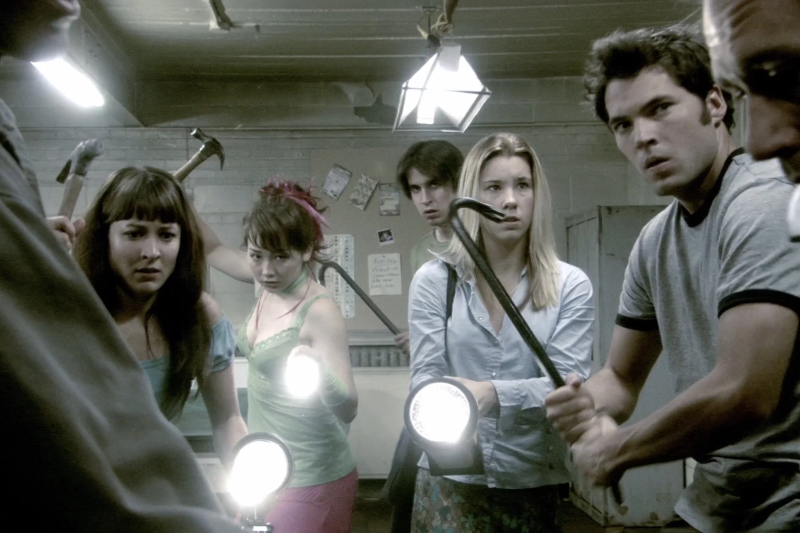
The centerpiece of End of the Line is the Voice of Eternal Hope, a religious sect led by the charismatic Reverend Hope (David L. McCallum). The Reverend is everywhere in the opening minutes of the film; we see his television commercials run in the background of public spaces, and subway stations are littered with magazine stands spreading his gospel. But then, as people make their way home from jobs and nights out, an alert is sent to members of the Voice of Eternal Hope around the world. Suddenly, everyone in proximity to a cult member suddenly finds themselves on the wrong end of a crucifix blade, and the film is divided into two camps: our group of desperate survivors and the cult members who hunt them through the city's subway tunnels.
The world is ending, you see, and only through death are people spared the horrors of Satan’s resurrection. But while the Lovecraftian concept of a cult called to murder the world may seem like a straightforward exercise, End of the Line demonstrates a surprising amount of nuance in how it depicts faith. Each member of the Voice of Eternal Hope may be called to kill in the name of the Lord, but how they answer that call is anything but constant.
Betty (Joan McBride) is, by her own admission, one of the highest-ranking members of the Voice of Eternal Hope. While others may hesitate to “save” their first sinner, Betty undertakes her butchery in a state of near-euphoria, stabbing Mike (Nicholas Wright) in the back. Later in the film, Betty repeatedly stabs a pregnant cult member, handing that woman her dying fetus so that the two souls may enter the gates of heaven together. Despite the violence, there’s nothing cruel about the way Betty kills. She is gentle, speaking in a low voice to her victims to reassure them that this is all part of God’s plan.
Betty may be a monster, but unlike many characters in religious horror films, she does not lack the courage of her convictions. When she dies – forced to take her own suicide pill after being wounded, a dangerous transgression that the film suggests may keep the doors of heaven closed to her – she dies certain of her faith. She does horrible things, but she truly believes that she is saving souls, rooting her actions in a misshapen form of sincerity.
If Betty is the believer, then Patrick (Robin Wilcock) is the cult member who weaponizes faith for his own benefit. When we first meet Patrick – long before the cult is called into action – he is just another commuter on the subway tracks, harassing doctor Karen (Ilona Elkin) and assaulting young Julie (Emily Shelton). While other members of the Voice of Eternal Hope are uniform in their ties and buttoned-up shirts, Patrick’s own outfit is untidy, half-untucked and disheveled as a visual nod to the apathy of his religious practices.
Patrick is a sociopath, and Wilcock leans every bit into his character’s wide-eyed, Busey-esque mania. Where other cult members kill, he mutilates. Where others celebrate their purity, Patrick tries desperately (and violently) to ditch his own virginity. And in the film’s final minutes, as Patrick stalks Karen around the darkened corners of the subway tunnels, he admits that he has seen no signs of God, instead offering Karen “ringside seats” to see if Satan really does return to earth. What he does, he does only to satisfy himself.
(Perhaps the film’s most bleak suggestion is that, by getting stabbed in the throat before he can assault Karen, Patrick has secured a place in heaven. Whatever version of God the Voice of Eternal Hope members believe in, he’s a righteous asshole.)
Because Betty and Patrick exist on opposite ends of the belief spectrum, we can wrap our heads around their motivations – cinematically, anyways. But then there’s Jerry (Robert Vézina). Jerry is one of a handful of Voice of Eternal Hope members we follow throughout the film, but unlike many of the true believers, Jerry seems to be an unwilling accomplice in most of the murders. He constantly pleads with others to walk away, even holding back as others carve into strangers on the train. When Jerry finally does turn his weapon on someone else, he does so reluctantly, being bullied into stabbing a fellow cult member by his peers.
Jerry is the cult member whose actions linger longest after the film is over. While McBride and Wilcock get to play their characters broadly - with a grotesque display of religious mania or gleeful violence – Vézina only ever plays Jerry as a coward. Had the rest of the cult left Jerry unattended, he might have fled into the subway on his own – but because his friends keep a watchful eye on him, he is dragged through the motions of murder and suicide alike, whimpering to his companions every step of the way.
Betty has the courage of her convictions. Patrick has no convictions. Jerry knows better and does horrible things anyways, which makes him the most relatable – and most unforgivable – of them all.
End of the Line is a charming no-budget nightmare, but one with a surprising nuanced look at the dangers of dogma. Faith is a spectrum, not a binary. By giving us a trio of cult members whose own beliefs vary wildly, Devereaux creates a rapture narrative with surprising variance and depth. And Betty, Patrick, and Jerry are not the only members of the Voice of Eternal Hope who are explored onscreen. End of the Line embraces a wide range of devoutness among church members, even showing what happens to those who attempt to leave the church – or those who just attend each Sunday to impress their significant other.
End of the Line may not be The Leftovers, but set aside the low-budget gore and the goofy demon costumes and you’re still left with a surprisingly effective examination of why religion and faith are not one and the same. And even if the film heavily suggests that the Voice of Eternal Hope was, horrifically, on the right side of history, there are still ideas here that can carry over into our everyday life. How far would you be willing to go to validate your own belief system? It might just depend on the size of your crucifix knife.