


Are you convinced that Hollywood didn’t need to make a Faces of Death sequel? Don’t worry: Daniel Goldhaber and Isa Mazzei are counting on that. In their latest collaboration, the duo behind Cam and How To Blow Up a Pipeline have seemingly been given carte blanche to reimagine one of horror’s most infamous video nasties. But rather than embrace or subvert the original, Goldhaber and Mazzei have crafted something more complex: a meta-sequel that seems barely interested in the original's existence (and for the better).
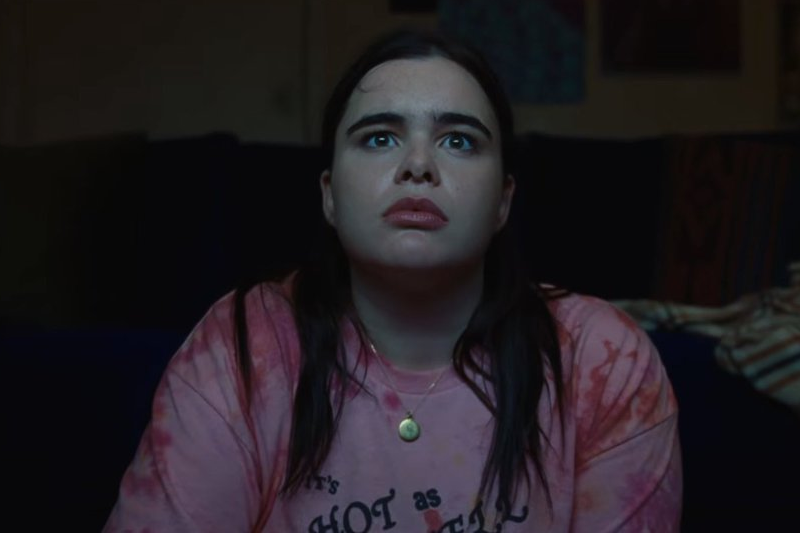
After a social media stunt goes terribly wrong, Margot (Barbie Ferreira) dedicates herself to content moderation. Taking a job at a TikTok-esque social media platform, Margot spends her days scrolling through videos flagged by the community, making real-time decisions as to whether the material should be allowed or marked for deletion. Call it atonement – Margot has never forgiven herself for her own misguided attempt at virality, and she quietly shuffles between work and her apartment, avoiding public settings for fear of being recognized by strangers.
And while her workplace has strict policies around bringing your work home with you, Margot begins to recognize one particular content creator in her queue. In these videos, a red-eyed man in a mask enacts elaborate death rituals, seemingly decapitating or electrocuting strangers accompanied by a dispassionate voiceover. The more Margot researches the origins of these videos, the more she becomes convinced that they are real, putting her friendships and her job at risk as she chases the masked killer down a rabbit hole of 1970s exploitation cinema.
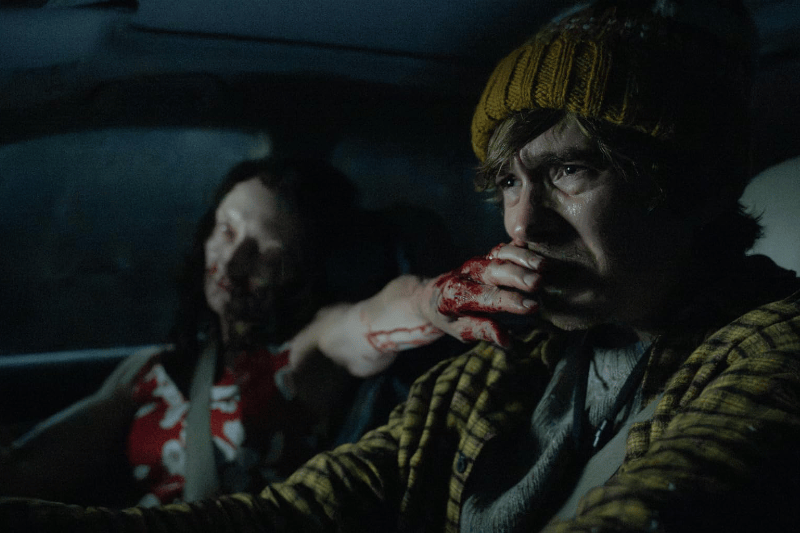
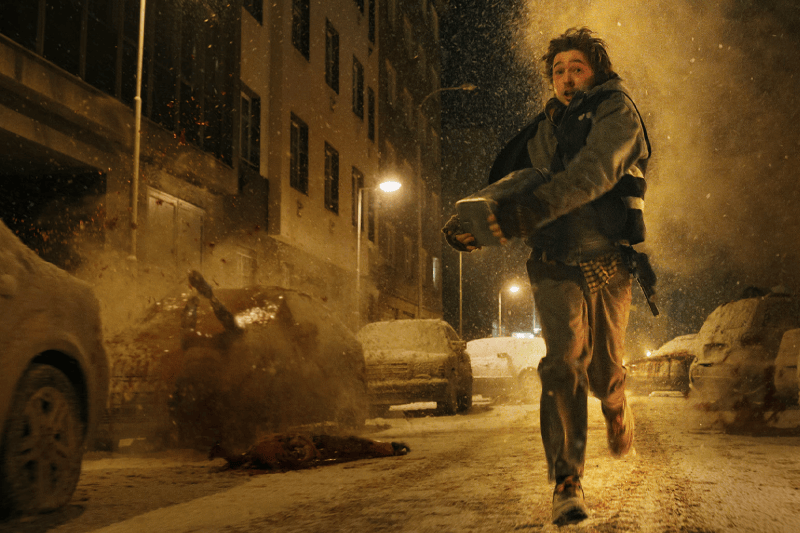
Meanwhile, the killer – Arthur (Dacre Montgomery), obvious from the jump – is perfecting his own relationship to death. Addicted to the algorithm and inspired by the original Faces of Death movie, Arthur turns his suburban environment into a slaughterhouse, recreating infamous death sequences for his ever-growing audience. And as Margot veers closer to finding Arthur, Arthur returns the favor, working towards a violent finale with one of the few people to appreciate the appeal of death gone viral.
In their two previous films, Goldhaber and Mazzei have aimed their lens at the economic struggles that underpin polite society. Cam, their first collaboration, built a digital ghost story from Mazzei’s personal experiences as a camgirl, while How To Blow Up a Pipeline adapted a nonfiction book of the same name with an urgent story of youth in revolt. Now three movies into their careers, their work occupies a unique space between the real and the unreal, layering elements of cinema and documentary to tell stories that are one fewer degree of separation away from the real world than we might like.
Faces of Death is no exception. There’s a through-the-looking-glass feel to their latest collaboration, which seems capable of breaking out of the screen at any given moment. But for as much as the film explores the like-and-subscribe violence of social media feeds, its most sobering sequence is one where Margot and Arthur circle each other online. Margot, who clumsily shares her findings with a community of self-appointed sleuths on Reddit, clicks on an encrypted link about the disappearance of one of the victims. As she pulls together the timeline from public sources, Arthur uses his job at a carrier network to track her down. Shown in the film’s single use of split-screen, this sequence embraces ‘70s stylization to remind us that there’s no such thing as digital privacy.
The decision to frame Faces of Death as a meta-sequel to John Alan Schwartz’s original film is also a surprisingly effective decision, in no small part because it’s barely relevant. Goldhaber and Mazzei use the 1978 film as a jumping off point, but the specifics of the movie seem to matter little to the filmmakers – and even less to the characters themselves. Arthur uses Faces of Death because the algorithm likes sequels, he explains, but the movie makes a point of not making a point about any textual significance. Arthur could just as easily have chosen, say, Douglas Hickcox’s Theater of Blood as inspiration. For Arthur, and Faces of Death, being derivative is a feature, not a bug.
But if Goldhaber and Mazzei err on the side of being too heavy handed – more broad in their moralizing and lacking the white-hot focus of its predecessors – they’ve still crafted a film that haunts. There are moments of absurdity peppered throughout Faces of Death that linger long after the movie is over, depictions of our culture’s coziness with violence that challenge us to condemn them as overwrought. In one such scene, Arthur answers their door in suburban America holding an assault rifle, knowing full well that his neighbors cannot be bothered to notice. It’s all part of the film’s matter-of-fact approach to Arthur, which includes the absence of red herrings or misdirects. Arthur isn’t an unknowable monster or a tragic twist of fate. He’s just a shitty human being with a platform.
What holds the film back is its inconsistency. So much of the film operates more in short bursts of ideas. The performances, too, often seem out of sync; Ferreira delivers a (too broad) performance that borders on the manic, whereas Montgomery can be seen as more style than substance – a Jared Leto-esque psychopath with no interiority. But it’s easy to recognize greatness in a film that does everything right. It’s much harder – and, frankly, much more entertaining – to wrestle with a movie that swings through its pitches almost as often as it connects. Those who hate Faces of Death will have good reason to do so, and those who love it will have plenty of evidence to support them. Grappling over the legacy of this one will be fun. At the very least, we can all agree that it’s worth the effort. [3/5]