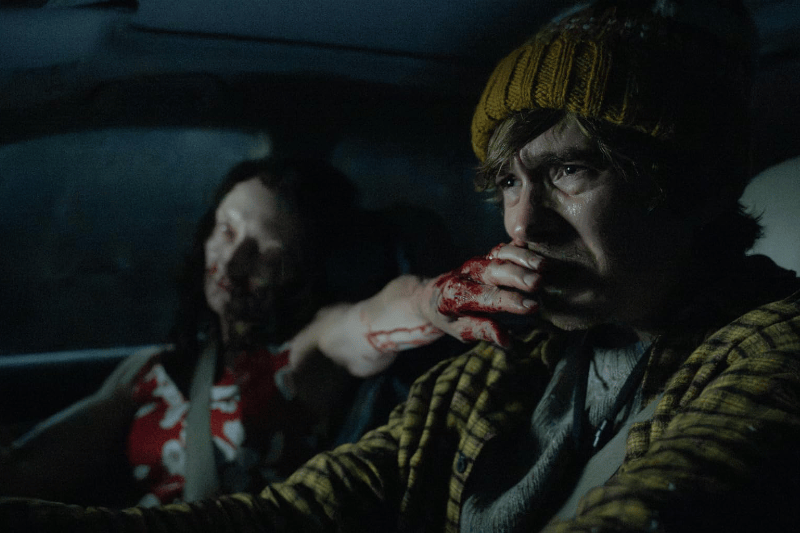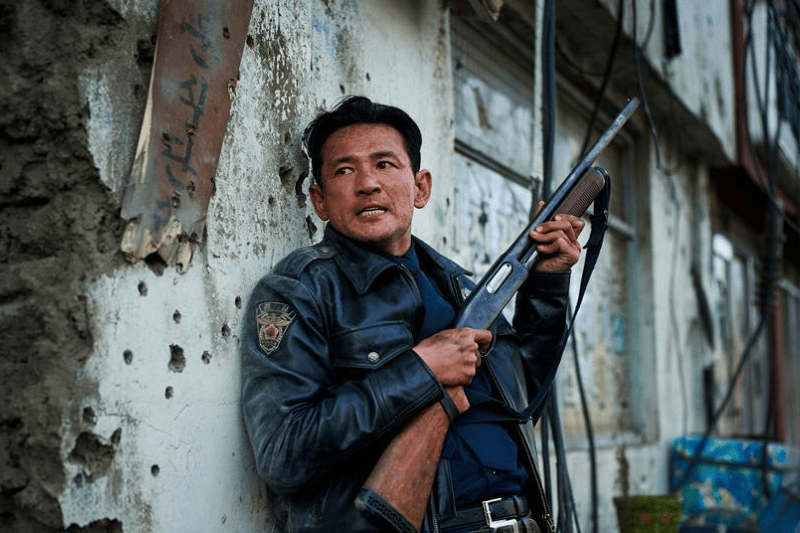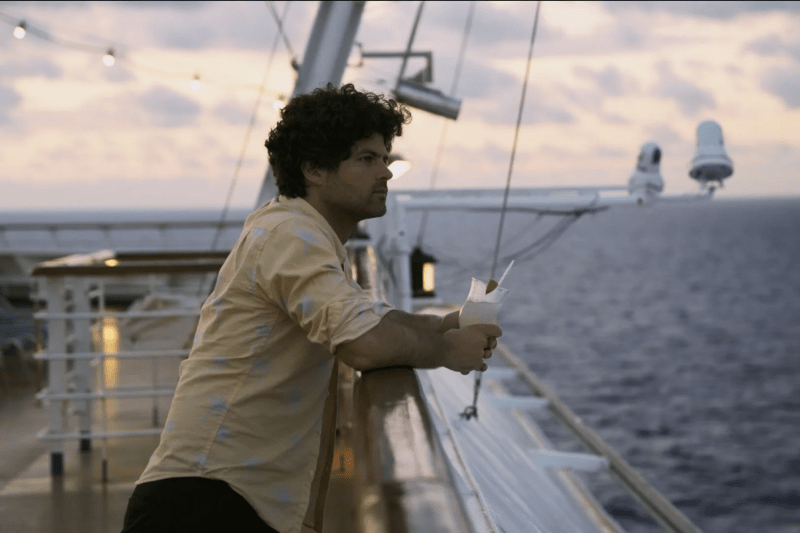



An open red sky. Meteor showers that ravage everything. Sick animal carcasses littering the roads. A count down, on the local radio station, to the end of the world. Based on the 2018 novel by Ana Paula Maia and directed by Marco Dutra, Bury Your Dead (Enterre Seus Mortos) follows Edgar Wilson (Selton Mello), a roadside animal carcass collector, alongside his colleague, the excommunicated priest, Tomás (Danilo Grangheia).
Edgar is rough around the edges. He barely talks, and when he does, it almost sounds inhuman – like a wounded animal. He spends the last days of Earth doing as he is told by his employer and lover, Nete (Marjorie Estiano). He collects dead animals on the road, sends them to the grinder to become compost. He hides from meteor showers, has dinner with Nete and her aunt Helena (Betty Faria), has sex with Nete, and sleeps.
Despite his harshness he lives a normal life. Except for the nightmare. The same one he has every night. His mother and father hold a young and sickly version of him by their home’s gate, a Catholic congregation approaches and prays. They pray and pray, until one of the young girls starts to bleed from the mouth. The images haunt Edgar to the point of violent somnambulism.
And this is how the issues in Bury Your Dead begin to arise.
The world occupied by Edgar and the people around him is dead. It’s not a matter of if but rather of when it will come to an end. And in this certain doom, as to be expected, a variety of reactions comes up.
Some simply go about their life, working and then drinking at the local bar in Abalurdes — a mix of Abadiânia, the town in Brazil where cult leader João de Deus used to live, and Lourdes in France, a catholic pilgrimage area. Most spend as much time as possible with loved ones.
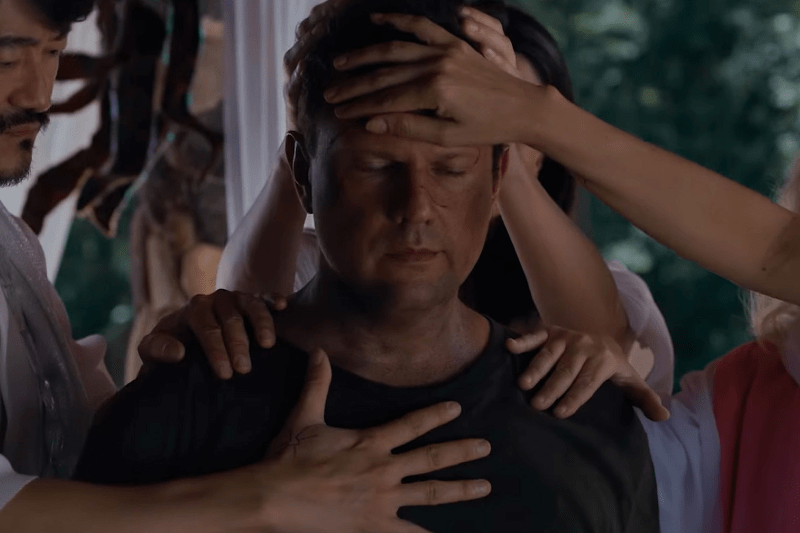
But some refuse to accept. Soroche is an eschatological cult that believes in an initiation ritual, where one must drink three servings of a mysterious tea to unlock a “connection” to the universe and transcend death at the apocalypse. Their presence is constant. Neighbors, police officers and even Nete’s aunt are part of the group. And they are hell bent in recruiting Edgar.
Nete’s aunt, Helena, believes Edgar's body and mind are cursed with death and the only way for him to be free is to join Soroche.
It is in this conflict that the film blossoms. Because instead of approaching the theme of religiosity looking to answer who is “right” or “wrong”, Bury Your Dead prefers to ask why. Why, in a world where humanity is slowly dying — most kids are infected by the same virus that is killing animals, and the sky is literally falling — would someone resort to religion?
For as long as humans have existed, the vastness of Earth has been against our thriving. The only way we had of surviving was to stick together, as a group. But keeping a big number of people together can be difficult. Opinions diverge and conflict ensues. Unless… there are no divergent opinions, everyone agrees on a set of principles and ostracizes those who break this sacred covenant to humanity’s survival. This is how, to an extent, religions are born.
And this is also how a lot of the religiosity shows up in Abalurdes. Soroche, the cult, arises from a sense of desperation. The vast world is coming for humanity once again and they must find the behaviors that will grant them a way out. The group does not want to accept that their bodies will succumb to death, just like any other creature, human or animal.
The “why” for these people is simply a need to control something they can not. The search for meaning in things that are completely arbitrary, disregarding reality and often others’ experiences for the sake of “the ultimate goal”, beating death.
On the opposite side of Soroche we have Edgar. Someone who seems to have an existence completely grounded to the physical world. More like an animal, going from moment to moment. To him, Soroche not only represents a futile search, but a group that seeks to get rid of everything that makes us humans, including experiencing death as is.
This animosity grows throughout the movie and culminates with the train tracks scene.
After Nete finally takes the final dose of Soroche’s tea, she has a psychotic episode and dies. Unaware, Edgar is called to go clean up whatever is attracting the vultures to the tracks, leading him and Tomás to find Nete’s body and decide to break protocol of leaving humans behind and find a better place for her to rest.
They journey to the big city and when Tomás discovers what Edgar’s plans are for Nete’s body, he decides to intervene.
Tomás is a priest, a representative of institutionalized religion, but he is also excommunicated. And not for some small issue, like losing faith, but rather for muder. But the interesting part is that his decision to kill is framed as coming out of his principles.
Which is an interesting contrast to the other two main characters.
Edgar holds a world view completely devoid of humanity. He is not cruel for the sake of enjoying others' pain, but rather he is much like a wounded animal, doing what it has to do to survive. Yet, this does not stop all the pointless pain that he has caused to come back to haunt him.
He is a prisoner of his own impulses.
Nete sits at the other end of the spectrum. Her welcoming of the Soroche process, reflects human need for things to make sense, to find a pattern that they can not control, to hold something that is completely out of their reach — to beat death. Which leads to the exercise of deliberate, even if coming from a place of desperation, violence.
The irony is that, much like Edgar's impulse prison, the calculated violence Soroche implements is hurtful to themselves, represented by Nete’s death.
It is only Tomás, who, for a priest, lives a very secular life — goes to bars, has casual sex — who is trying to implement religious principles in his actions. He isn’t sure souls are a real thing, but he sure knows that showing compassion for others will lead to a better reality.
So, despite being ostracized by the traditional institutions of religion, Tomás represents the faith that goes beyond manichaeist morality, but one that is grounded in people’s reality and what you can do in your world.
As someone who grew up on a church pew, full of questions and surrounded by people who — at least to me — sound like the Soroche group, it was easy for me to grow up full of resentment and hurt toward any religious line of thought.
After years of witnessing people spewing lies from the altar, twisting meanings and exploiting real life suffering to advance an agenda, religion felt like a trap that I had to escape.
Much like Edgar, to me religion was just a form of control, a prison for those too weak to deal with the painful reality of the world. And slowly, that resentment — not the lack of religion, still an atheist! — made me lash out. I was the wounded animal.
And much like Tomás, who is also wounded and full of questions, the only way I found to crawl out of that pain was through honest curiosity, empathy and an openness to those who are different then me. Ironically, some of the core principles of the religion I had stepped out of.
To me the three main characters in this move perfectly encapsulate the religious experience. Extremists, more worried about dogma than people living them. The religious trauma that can often generate the same type of violence, just on the opposite end of the spectrum. And the actual philosophy of why religion comes up in human society.
Watching their dynamic throughout the film was, personally, very cathartic. After all, Bury Your Dead is not worried about giving you answers. Rather it prompts you to ask yourself why you believe in what you do. Why do I keep believing in it after you have found the cracks in its structure? And what does it mean to have a belief in a world that is made to exploit such?