



Those darn liminal spaces are just so hot right now. Perhaps owing to the slow collapse of societal infrastructure, or the vague sense of wrongness that seems to pervade our every waking hour, horror media (and video games in particular) are turning to the shapelessness of liminal spaces to elicit new scares. This is the premise behind shows like Severance and upcoming movies like Backrooms, and it’s also the driving force in Genki Kawamura’s Exit 8, the big screen adaptation of indie video game The Exit 8.
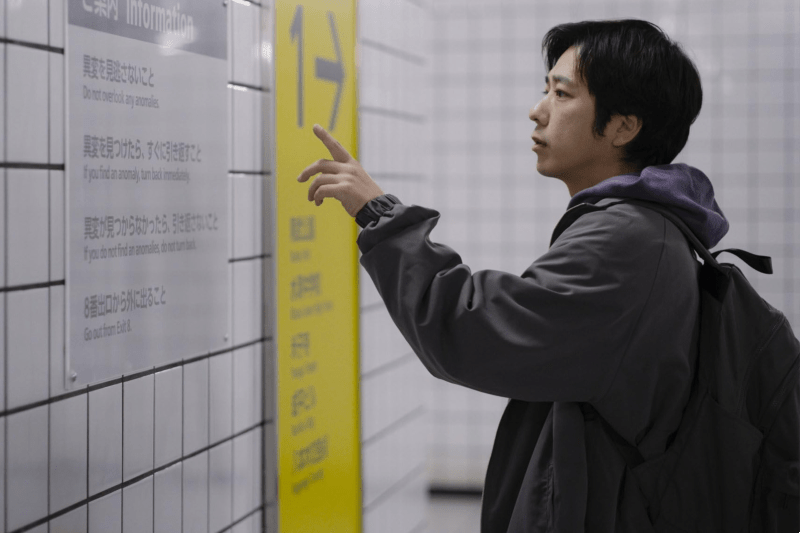
We never learn the name of the man lost in the subway; we only know him by the description given him in the credits. But name or no, the Lost Man (Kazunari Ninomiya) is adrift. When we meet him on his first commute to his new entry-level position, he is wrestling with the news that his ex-girlfriend is now pregnant. She is undecided what to do and looks to him for support; he is incapable of making a decision and stammers his way through an awkward phone conversation. His mind elsewhere, the Lost Man wanders aimlessly through the station hallways, only slowly realizing that he seems to be repeatedly passing through the same corridor.
Thankfully, there’s a sign on the wall with simple instructions: if you see an anomaly, turn back. If you don’t, keep going until you reach Exit 8. It takes the Lost Man a moment to overcome his confusion, but he soon takes inventory of his surroundings and runs through a simple checklist each time he comes upon the main hallway. Here there are subway signs; there he sees the Walking Man (Yamato Kochi), the impassive commuter who stalks the halls with his briefcase in hand. However, the closer the Lost Man gets to Exit 8, the more varied the anomalies get, until the Lost Man begins to lose all hope of ever finding his way back to the surface.
In a nod to the game, Exit 8 opens with an extended first-person sequence as the Lost Man waits to disembark from his train. While it would be unrealistic for director Kawamura to stick with this perspective for the entire film – for all its variety, first-person cinema remains more gimmick than immersion – the internalization offered in the opening sequence serves the movie well. We hear what the Lost Man hears, and, more importantly, what he chooses not to hear, popping his earbuds back in to ignore the harassment of a single mother near him. This tension between his active and passive engagement sets the stage for the unraveling that will follow.
Exit 8 isn’t a film built around story so much as perspective. Over the course of the movie, we will join each of the three main characters – the Lost Man, the Walking Man, and the Boy (Naru Asanuma) – as they wander the same stretch of hallway over, and over, and over again. While the film does hint at some familial connection between the three, each of the characters is more of a rough sketch than a three-dimensional person. That’s not a bad choice for a film that is entirely reliant on production design; what little narrative does exist is in the characters’ reactions to the anomalies, which Kawamura and company keep appropriately varied throughout.
If anything, this adaptation seems to capture the feeling of watching someone else play through a video game – adapting the highlights of the player experience for audiences. We may not feel an intense sense of ownership over the Lost Man and his struggles, but we can appreciate the setting and the way Exit 8 repeatedly refreshes the environment. From simple jump scares (most of which involve the Walking Man) to more complex transformations of space and color, Exit 8 is built on wrongness, not fear, and that gives the movie a great deal of latitude for success. It may not transcend the language of video games for the screen, but it picks and chooses the concepts to exploit with care, and the result is a thoughtful excursion in adaptation.
That means the driving force of Exit 8 is the curiosity of its viewers. Each time the Lost Man turns the corner back to the main hallway, we wonder what, if anything will be different. Once we’ve observed changes both big and small, the film wisely begins to wind down its story, favoring a few tender moments between the Lost Man and the Boy before the biggest anomaly to date wipes their slate clean. At a brisk 95 minutes, Exit 8 does not overstay its welcome, even though our interest in it remains more intellectual than emotional.
It shouldn’t be long before Exit 8 sits alongside Vincenzo Natali’s Cube as cult classic cinematic mystery boxes. Both films pair immaculate production design with existential dread, and moviegoers who prefer their films to be puzzles in form as well as in narrative should be quick to embrace this one. And if you find yourself wanting more from this world, well, The Exit 8 is available to purchase for only a few dollars on most major platforms. Even after decades of releases, there are precious few games that have successfully made the leap to screen. Here’s to the Lost Man escaping at least one liminal space by the film’s end. [3.5/5]