


There has long been a hope that outdated conservative ideologies will simply die off with the generations that hold them so dear. But unfortunately, that is not the case. In the United States, young men specifically continue to be indoctrinated into sexist, homophobic, and racist rhetoric. These young men have little knowledge of why things like the “Me Too” movement are important, and instead feel victimized and attacked. And while we not so heroically fought against ideals like Nazism during WWII, these ideas are alive and well in the United States. While it was made in 1969, Juraj Herz’s film, The Cremator, is as timely as ever. The Czech New Wave director and concentration camp survivor paints a deeply accurate portrayal of the types of men that become indoctrinated into these mentalities in a way that is uncomfortably accurate to what we see today.
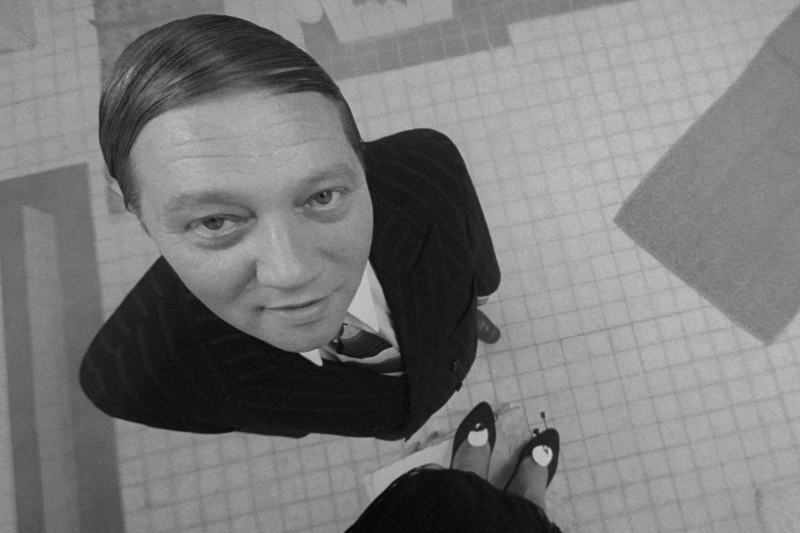
The Cremator follows Kopfrkingl (Rudolf Hrušínský) a mild-mannered and somewhat creepy family man who runs a crematorium. He believes that cremation relieves human suffering and allows for the soul to move on to the next life sooner than burials. The film is ultimately a character study of Kopfrkingl as we see how quickly he is able to morph his ideas to fit in with the burgeoning Nazi party. Through never-ending monologues and expertly edited quick cuts, you get a sense of how easily this man is manipulated into offering up neighbors, friends, and even his family members as “necessary” sacrifices as he moves up the ranks within the party. Kopfrkingl, like many terrifying figures in an ever growing authoritarian state, is laughably stupid, but that stupidity mixed with power and influence breeds something horrific.
Kopfrkingl is a man with both an inferiority complex and a god complex. He is filled with such contradictions. He is unsuccessful and the majority of their living expenses are paid for by the fortune his wife inherited. He is a penny pincher and has terrible hygiene. He has no qualms about cleaning his finger nails at a public restaurant, eating meat with his hands at work, or using his comb to brush his hair and that of a dead body in the crematorium. He also has the gaze of a pervert. While purchasing art for his family home, his eyes constantly dart to all of the paintings with depictions of naked women (although he ends up buying some other random artwork instead). While acting like a loving husband and father, he has no problem going to visit a sex worker regularly or harassing one of the young cleaning women that he works with.
He also has little consideration for what he discusses in front of people. He often goes on morbid ramblings in inappropriate social gatherings, including his daughter’s birthday party. And while he seems like a man with strong ideals, we watch as he becomes malleable and easily manipulated by the ideas of those around him, especially Reinke (Ilja Prachař) an old war buddy who sways him to join the Nazi party.
While it might seem ridiculous how easily and quickly Kopfrkingl betrays those closest to him in The Cremator, when we look at the flimsy reasons people support MAGA or extremist groups, it does hit a little too close to home. Reinke speaks to his sense of masculinity, and boosts him up like a manly man in a way that no one else around him does. He invites Kopfrkingl and his son to attend a boxing match in an attempt to further push this sense of manliness onto the both of them. And when the match is over, Nazi propaganda flies from the rafters onto the crowd – it all feels very Andrew Tate pre-internet. What really seals the deal, however, is the promise of young beautiful blonde women up for the taking. As soon as he attends one of their gatherings where he is surrounded by half-naked women, Kopfrkingl gives up his neighbors and barely flinches when they suggest his family needs to go as well. And the abstinence from alcohol and tobacco that he often brags about falls away as soon as he gets the slightest hint of peer pressure.
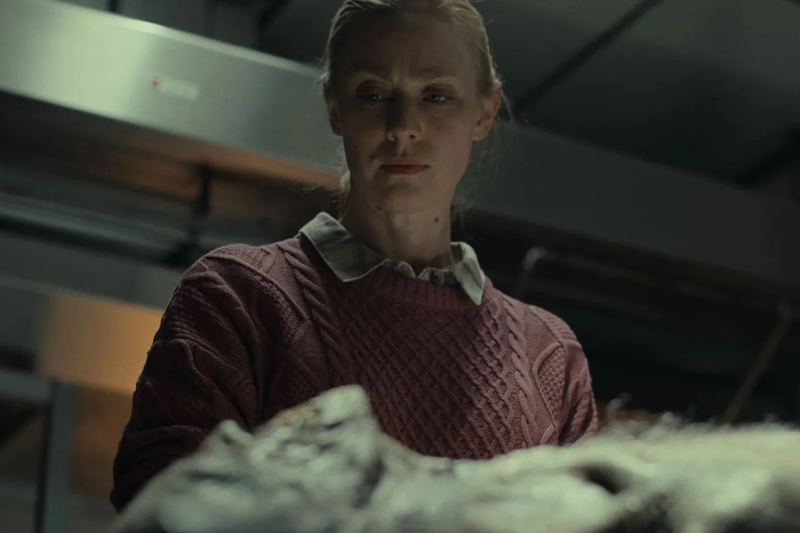
Was Kopfrkingl already a murderer? Or were some of those violent tendencies simply lying dormant? Throughout the film, there is a ghostly long-haired woman who follows him, yet no one else can see her. He is also so quick to figure out how to cover up his crimes. There is a metal rod leaning against a wall in the room that houses the bodies prior to cremation, which he uses to kill his son and then throw his son’s body in with one of the other corpses before they are cremated and all evidence is gone.
Is it possible he did this with the woman that haunts him? Would he have done this to the young cleaner he was infatuated with if she had not quit? There is nothing concrete, but it's worth speculation. He makes his wife’s death look like a suicide – one that bears a striking resemblance to the deaths he is shown in the wax museum he attends with his family. Because if there is one thing that Kopfrkingl isn’t, it's original. All of his ideas are plucked from things he reads and those around him. Throughout the film you will hear him repeat lines other characters said that he attempts to pass off as his own.
One of the scariest things about The Cremator is how someone doing such terrible things can justify them and conflate them with being heroic. While his interest in Buddhism feels completely divorced from his interest in Nazism, he manages to blend them into one singular ideology in his head. Once he sets out to murder his family, he begins hallucinating himself as the reincarnation of Buddha, and believes that by killing he is actually saving them from the suffering that is to come.
In the end, he is told that he will be in charge of the large-scale crematorias that would be used to cremate all of the victims killed in the concentration camps. For some historical reference, Auschwitz had three large scale furnaces that could burn 340 corpses every 24 hours – a horrific detail that bears repeating considering how we see history repeating itself now. Kopfrkingl is delighted that he will be able to “save” so many souls in these large furnaces. He fantasizes this while standing in front of Hieronymus Bosch’s painting titled The Garden of Earthly Delights, specifically the right panel that shows his depiction of hell. While The Cremator is a rather bleak film, you cannot help but notice the dark sense of humor that Juraj Herz sprinkles throughout.
The Cremator, unfortunately, is as timely as ever, and because of this, it feels like an essential viewing. People are quick to forget the horrors of the past, often seeing things as truncated events instead of a chain of events that build upon each other. If we wanted to truly “never forget” the atrocities of the past, we would do more to set a framework for the future. We would take on the root cause of systematic violence, we would educate and socialize men better, and we would see the real causes of these horrible events. Which, yes, are unfortunately capitalism and the patriarchy.
We often try to fix a gushing wound with a band aid as opposed to doing the real work that would make change for the better. And because of this, we continue to let horrible people take control, ruin lives, and indoctrinate men. Kopfrkingl in The Cremator is scary because he is so malleable, which has much to do with the fact that he does not stand on any strong ideals or sense of self. This allows for him to become a traitor to everything that should hold meaning in his life. In the end, Kopfrkingl is scary because he, like many men today, is quick to become a follower to toxic men and their unspeakable acts.