

While it abounds with big ideas, Maggie Gyllenhaal’s The Bride! ends up barely coherent. Its debonair performances and potent designs clash wildly with its scattered execution, resulting in a major swing for studio horror that misses in puzzling (if not outright embarrassing) ways. Its imaginative tale of a scorned woman brought back from the dead is, ironically, pretty to look at but lifeless underneath, despite its gestures in the realm of feminist empowerment and cinematic self-reflexiveness. It is, in short, a movie kind of, sort of about movies themselves, with distant echoes of patriarchal violence somewhere in the backdrop, but it may as well be about nothing at all.
The film takes broad hints from James Whale’s 1935 Universal monster feature Bride of Frankenstein which, in addition to introducing Elsa Lanchester’s iconic, lightning-streaked “the Monster’s Mate” — a staple of pop culture, despite her mere 4 minutes of screen time — also featured a framing device in which Lanchester plays Frankenstein; or, The Modern Prometheus author Mary Shelly, who teases an untold story. The suggestion that Whale’s sequel is this secret text makes roundabout sense, since it adapts parts of the 1818 novel which his original Frankenstein discarded or condensed. The Bride! begins similarly, with an eerie, monochrome vision of Shelly (Jessie Buckley) trapped in some shadowy, purgatorial realm as she addresses the camera from beyond the grave. The film we’re about to watch, she claims, is a version of the story she couldn’t initially tell, before she died of a brain tumor at 53.
Stay in touch
Sign up for our free newsletter
This is where the movie’s most fascinating and most exasperating concepts emerge. As we’re introduced to our protagonist, Ida (also played by Buckley), a blonde woman in 1930s Chicago, Shelly begins speaking through her, via some crack in the film’s fictition. Like a hidden personality within her subconscious, Shelly causes Ida to interrupt her drunken night out with friends by sputtering stream-of-consciousness synonyms in an English accent, as though the historical author were leaking into Gyllenhaal’s dramatization through spiritual possession. What follows is an equally stream-of-consciousness plot — for better or worse — as two men from Ida’s group take her aside and try to slap her into her senses, leading to an accidental tumble down the stairs and a fatal injury. It’s worth noting, however, that a more intentional demise might have suited the movie’s themes (not to mention its malformed B-plot about a mafia boss who silences women).
On one hand, the idea of a film in which reality and fiction are separated by a razor-thin membrane, and in which an author is granted a pathway to resurrection through a character, is a wonderfully zany idea. On the other hand, the suggestion that Shelley — one of the most studied authors in history, whose miscarriages informed her writing in visceral ways — may have been so artistically constrained that the The Bride! must liberate her intentions is, at best, anti-intellectual. However, like Chloé Zhao’s recent Hamnet, which re-interprets Shakespeare through a lens of personal grief, Gyllenhaal’s film deserves the benefit of doubt, at least at the outset, and especially if it can conjure a story equally visceral in its pursuit of historical re-imagining.
(Spoiler alert: it does not.)
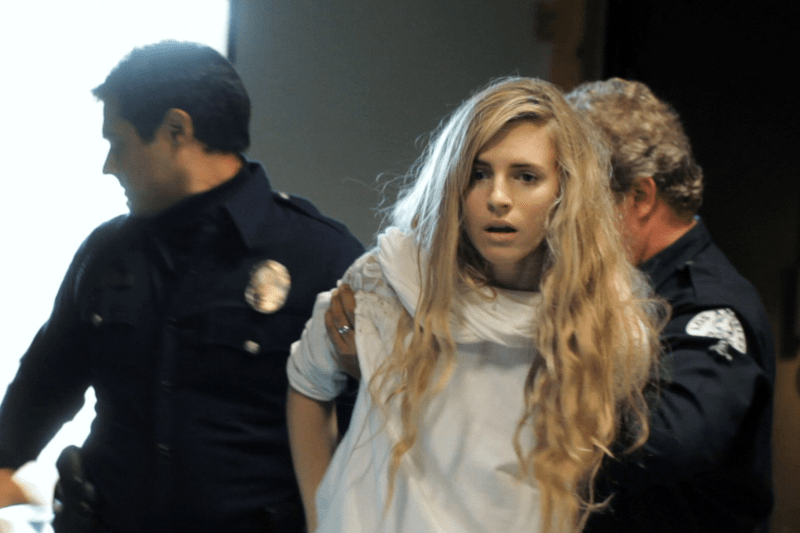
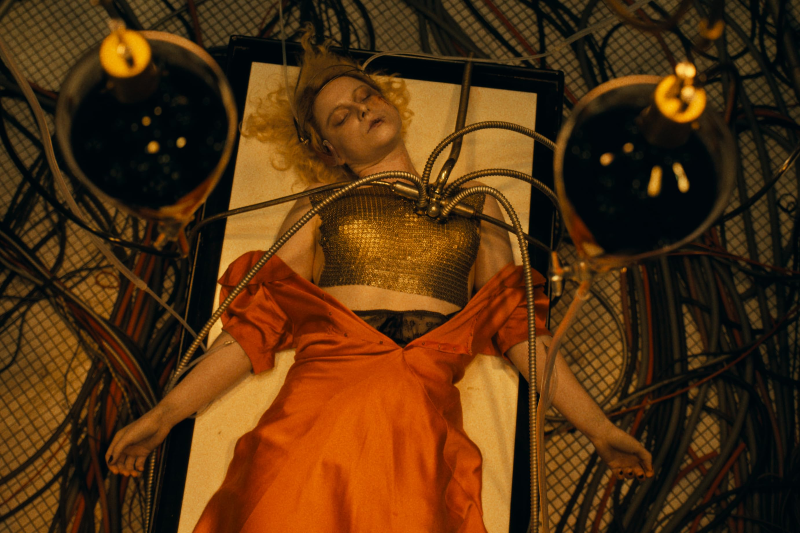
The film kicks off in earnest when a now century-old Creature, or Frankenstein’s Monster, a.k.a. “Frank” (Christian Bale) covertly approaches the renowned Dr. Euphronious (Annette Bening) in disguise, with a request meant to soothe his loneliness: the creation of an undead companion. The doctor quickly agrees — anything resembling an ethical dilemma is swept under the rug — leading the duo to dig up Ida’s fresh corpse and re-animate it in the style of Whale’s original, electric contraptions and all. Gears whir like film projectors, as lights beam into the darkness of Euphronious’s workshop. The Bride is zapped back to life with copyright-skirting frizzy hair (Shelly’s work is in the public domain, but WB doesn’t have the rights to Universal’s designs). Upon her resurrection, she pukes out a black bile that stains her cheek, in a particularly delightful scene.
The film is at its strongest here, when Buckley re-awakens in this messy visage, and Gyllenhaal frames this process as the product of cinematic dreaming. After all, there are Hollywood references galore, and Frank spends much time at the movies, watching the exploits of delightful musical star Ronnie Reed (a severely underutilized Jake Gyllenhaal), while picturing himself — staples, rotting flesh, and all — as one of the stars on screen. However, this is also where the movie’s self-reflexive qualities start overwhelming its more basic dramatic tenets.
The amnesiac Bride doesn’t know who she was before her death, but lack of identity doesn’t seem to inform her journey very much. She’s also taken, to some degree, by Frank’s adoration, which leads the undead couple on an escapade to a seemingly queer nightclub populated by provocative dancers. Queer readings of Shelly’s text, as one of persecuting the unknown, have seldom received their due in cinema, but this hint of thematic innovation is turned quickly on its head when two of the patrons try to sexually assault the Bride. It’s best not to think of the unsavory implications, since this scene exists so Frank can be photographed mid-fisticuffs like a classic, hard boiled hero.
What follows is a strange, disjointed saga in the vein of Bonnie & Clyde, albeit sans the intricate assembly or subversive spirit. A detective, Jake Wiles (Peter Sarsgaard), seems to recognize Frank in the papers, though since the Creature has taken great care in hiding himself from the world, it’s not quite clear if they’ve crossed paths before, or if Frank was meant to be some kind of celebrity or well-known criminal in an earlier version of the script (Frankenstein’s… Mobster?), or if there was meant to be some other meta element at play, and Shelly’s work somehow exists within this fictional world. All these eventualities are interesting in concept, but none of them are broached, leaving even the basic premise a mystery. Jake also eventually recognizes the Bride and claims to hold answers about her past, but this is injected so late into the runtime that it feels completely perfunctory.
Sarsgaard’s lawman is assisted by his secretary Myrna (Penélope Cruz), who’s secretly the brains behind their operation, but is frequently underestimated by male law enforcement. This makes for the film’s most (and really, only) cogent commentary on historical misogyny, though it rarely blooms into its own meaningful subplot, let alone one that mirrors the Bride’s story. Elsewhere, she and Frank move from town to town, but you’d be hard-pressed to pinpoint a coherent objective behind their movements. Are they on the run? Sort of. Do they like committing crimes? Not particularly. Frank seems to want to visit locations where his favorite screen star filmed his movies, but this only ends up a temporary catalyst, leaving their actions with little motive or allure beyond visual allusions to early musicals and Film Noir.
Add to this the fact that it’s not even made clear, for a good hour of the runtime, what Frank has or hasn’t claimed to the Bride about her past before her resurrection, and you’re left with a film that scrambles to fit its biggest and most important pieces together. There’s the occasional dance number, which sounds delightful in theory, but it’s yet another element of The Bride! that’s tossed in at random, and thoughtlessly skirts the movie’s diegesis and self-reflexive elements. Both lead actors also mumble their lines on occasion, some of which get lost in the rumbling audio mix, further resulting in an indecipherable plot, and themes that are at best translucent, if not completely opaque.
At one point, the Bride inspires a revolution in the vein of Todd Phillips’s Joker — The Bride! notably shares its producer, composer and cinematographer with that film and its musical-inspired sequel — involving women who stand up to some vague, unseen specter of patriarchal violence and paint their faces like hers. However, this ends up a complete misfire. What she represents to these women, and what she or they are fighting for, is lost in a chaotic edit that skips forward with reckless abandon. By the end, even the idea that Shelly is speaking through the Bride (or that she might have anything of worth to say) ends up largely forgotten. What remains instead is a Scooby-Doo-like plot where hoodlum A chases detective B, who chases hero C, who chases side character D (and so on), and they all run in circles while reading dramatic proclamations from a hand-scribbled rough draft, until they finally collide in a confounding climax befitting one of J.K. Rowling’s Fantastic Beasts films.
Buckley is electric, and shoots for the moon with her erratic convulsions whenever Shelly seems to speak through Ida/the Bride, creating a unique physicality while elevating the film’s emotional simplicity. Bale, meanwhile, makes for a thoughtful, grown-up evolution of Boris Karloff’s childlike Creature from Whale’s Universal originals. Both stars are immensely committed to their parts, and throw themselves headfirst into the movie’s stranger elements. However, these seldom cohere around them, so the whole affair ends up feeling like a pastiche played far too straight. The actors are, at the very least, afforded the broad semblance of romantic drama, and they share an explosive physical chemistry, but what draws their characters together, or repels them, is rarely emotionally intelligible.
The Bride! spends far too much time playing hopscotch between the lines of fiction and reality to ever unearth the souls of its lead characters, let alone locate a point to its meta-textual approach. It consists only of empty gestures, strung together without a care for what any of its lofty, nostalgic images might mean, or what its story is meant to add to the lineages of horror, musicals, gangster pictures, or retroactive feminist readings of genre cinema. It’s hard not to think Netflix might have had the right idea jumping ship from the production. Maybe this one shouldn’t have been brought back to life. [2/5]