


On September 23, 1972, President Ferdinand Marcos declared a state of martial law in the Philippines, in response to alleged attacks by communist and Muslim rebels. In 1981, Marcos would formally lift the martial law proclamation. Later that year, on Christmas Day, Mike De Leon released Kisapmata. Setting the stage is important, because it is not often a movie so indelibly a product of its time and place like Kisapmata comes along.
Based on a crime reportage by Nick Joaquin published in 1961, Kisapmata follows the harrowing home life of Mila Carandang (Charo Santos). Mila is the only daughter of Dadong Carandang (Vic Silayan) and Dely Carandang (Charito Solis), referred to as Tatang and Nanang respectively throughout the movie (Tagalog for “father” and “mother”). Tatang rules his house with an iron grip, dictating every aspect of his wife and daughter’s lives. When Mila announces she is pregnant and intends to marry her coworker, Noel (Jay Ilagan), Tatang reluctantly approves of their decision.
Stay in touch
Sign up for our free newsletter
However, Mila and Noel quickly realize that even after they have married, Tatang will not relinquish his only daughter so easily. He follows them everywhere, demands they stay in his house, and leverages his own wife in order to control his daughter. What follows is a seemingly endless dance between Mila and her father, as she takes one step forward out of her family home, only to be dragged two steps back by Tatang. As Mila’s attempts to escape Tatang’s grasp are thwarted time and time again, something even more sinister than just her father’s rules rears its ugly head.
Kisapmata’s story of high tension and familial power struggles does not let its audience breathe. Due to Tatang’s constant surveillance, very little can be said openly or honestly between characters. The actors’ performances are both nuanced and purposeful out of necessity. Their actions must speak for themselves — an earthworm passes between palms, a gun is clandestinely stashed into a nightstand, Mila takes a glass of milk to Nanang just as a conversation between Noel and Tatang turns tense. Even Tatang keeps certain secrets and motives close to the chest, cackling boisterously one moment, only to become grave and immovable the next. The cast does an impeccable job of communicating how suffocating life has been for this family, and how things are doomed to become worse.
The film is based on a true case of familicide. With a retired police officer at the forefront of the story, the whole bloody affair was highly publicized, shocking locals and leading many to wonder why and how it happened. Joaquin’s reportage, “The House on Zapote Street,” is a sobering examination of the case, showing clearly how one man’s aggressive crusade for unchallenged control led to the deaths of his family and himself. For Joaquin, the heart of the story lies in the house itself — a superficial product of suburban development in a post-World War II Philippines. Joaquin reflects on the echoes of the past, mourning a rural environment paved over by suburbia during a time of overpopulation.
For De Leon, however, the case of what happened on Zapote Street would come to represent one of the most tumultuous eras of modern Filipino history. The real life murderous patriarch who would inspire the character of Tatang, Pablo Cabading, was a tyrant in his own home, manipulating and controlling his family in extreme measures. He was a retired police officer who kept guns for no apparent reason. He threatened violence upon his in-laws when he didn’t get what he wanted. In a coincidence so uncanny it almost defies irony, Cabading demanded that his daughter invite then-Senator Ferdinand Marcos, an acquaintance of his, to her wedding.
In the translation from reportage to film, very little about the Cabadings’ story was changed. It wasn’t necessary. The truth of the case became Kisapmata’s greatest asset, immediately immersing its viewers in its harsh and insulated reality. Kisapmata is a psychological and dramatic horror film, whose surreal omens live in black-and-white depictions of abstract nightmares, reminding the viewer that all of this can only end in tragedy. From the bleak landscape, to the high-strung music, everything about Kisapmata’s presentation serves to make the audience feel as unsafe as its characters.
However, there is one major liberty De Leon took in transferring the story to film. By including a horrifying incestuous relationship between Tatang and Mila, one that brings the parentage of her unborn child into question, De Leon simultaneously creates a conversation about nationalism in the Philippines and sets a new precedent for what qualifies as Filipino gothic. And just as the house of Usher collapses in on itself, burdened by the sins of its residents, Tatang gives into the horror and turns his gun on his family.
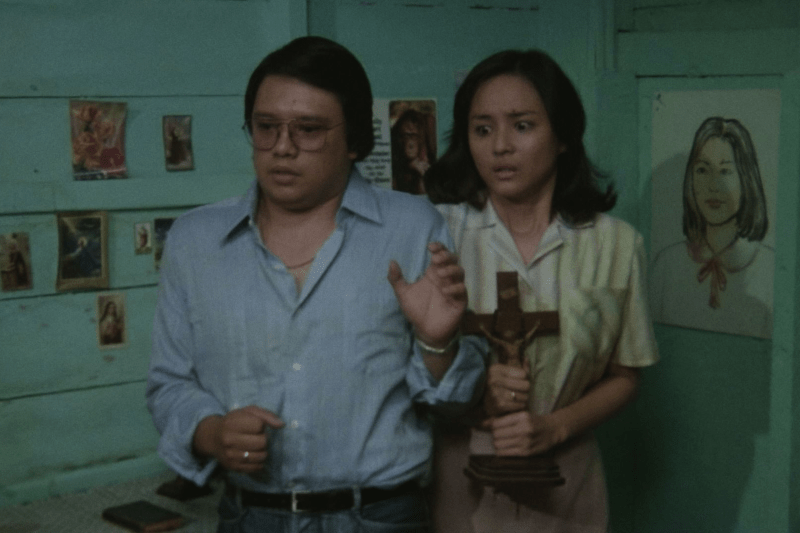
While Kisapmata may not seem traditionally gothic based on its appearance alone, any enthusiast of Southern gothic works will recognize the film’s landmarks of gothic presentation. For example, religion plays a major role in the lives of the Carandangs, specifically Catholicism. These details are pointedly mentioned in the reportage and visually reinforced multiple times in the film. Yet, the looming presence of Catholic iconography is not unusual for the average Filipino family, especially one from Luzon. Catholicism is a sacred tenant of Filipino culture, and it is not so unusual to find the same altars and decor in a typical Filipino home.
So present are these portraits of Jesus and crucifixes, that they speak to a cynical sentiment reminiscent of The Exorcist: God will not save these people. They can pray, they can plead, they can kneel to a Christian god, but, at the end of the film, the only entities here are humans. Just as William Friedkin resisted William Peter Blatty’s attempts to fully propagandize Catholicism, De Leon resists romanticizing or idealizing Filipino Catholicism.
And, as it stands with all gothic stories, the house itself is a character. De Leon praised production designer Cesar Hernando for finding a location which so closely resembled the house described in Joaquin’s reportage. A split suburban with an interior balcony overlooking the first floor, the house conveys both cramped living areas and a lack of privacy. An earthworm farm lies in the basement. As Mila looks on from outside the gates of her home, her sorrowful face is framed by a crude halo of barbed wire. Any homely or religious decor does little to conceal the house’s teeth.
As you may expect, Kisapmata is not an easy movie to watch, and it shouldn’t be. Carrying the weight of centuries of imperial oppression and the modern struggle against national identity, De Leon’s film refuses catharsis. And yet, it is not a film that lectures the viewer. Every element of the story is intrinsic to the telling and understanding of the world inside the film as well as the world that built it. It lays bare a true story, one that was too heavy to go untold, and one that is still unfolding today.