

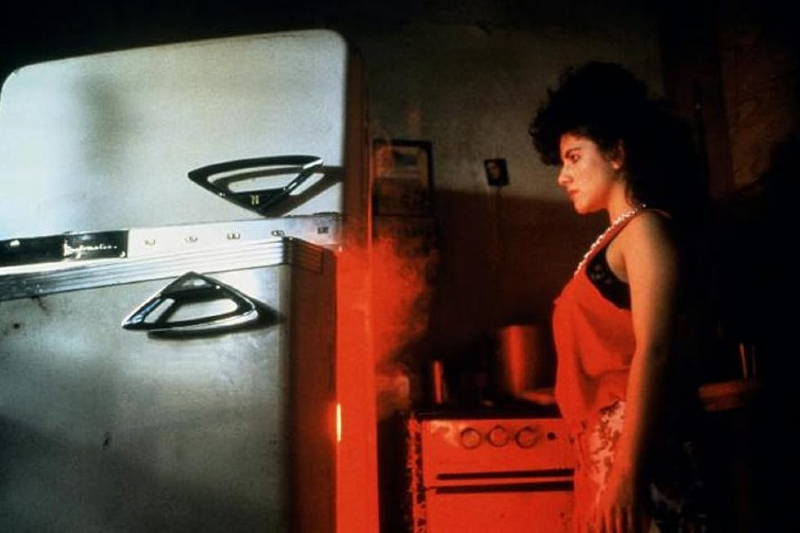

In the pantheon of beloved ‘barely a movie’ classics, such as Troll 2 and The Room, Nicholas Jacobs's The Refrigerator, a horror comedy about a killer fridge, deserves its dues.
Set during a sweltering summer in Manhattan, the film centers on a newlywed couple, Steve (Dave Simonds) and Eileen (Julia McNeal), who begin renting a suspiciously cheap apartment. Little do they know the place is a death trap thanks to the object in the title: the fridge – secretly a portal to Hell. It quickly drives Steve into an aggressive frenzy fixated on his cubicle-based job, leaving Eileen, who is trying to make it as an actress on Broadway, isolated and afraid.
Tonally, The Refrigerator is comparable to the aforementioned creature feature Troll 2, which was released a year prior. Both are ludicrous in premise, both also have plenty of awkward acting, clunky but instantly mimicable dialogue, and laughable threats. But while it never quite lives up to the true ‘horror’ part of its genre mash-up quota, The Refrigerator is intentional, not accidental, in its comedy.
Stay in touch
Sign up for our free newsletter
This isn’t the kind of turn-your-brain-off Wayans’ fare, or the grandiosity of Army of Darkness. It’s more akin to the satirical surrealism of David Lynch, wherein normal settings shift into waking nightmares, like your boss, Borrower-sized, giving you advice in a smoking jacket from the top shelf of your fridge. These moments are what give The Refrigerator its unexpected intrigue. It’s not always fully coherent, but you have to appreciate its ambition – especially for a half-million-dollar budget and, as far as I can tell, a finished product that is only streamable via bootleg on YouTube.
The film’s cold open establishes its weird blend of humour and fear, barrelling along in a car with a partying couple down Avenue D (“D for dog?” Steve asks the landlord later on, “D for diablo,” he corrects with a smirk, because what’s the point in owning a malevolent apartment if you can’t make jokes about it?). The couple race up the stairs to have sex, past a rogue’s gallery of cartoonish ‘undesirables’. No sooner has the man prematurely finished than the apartment’s fridge animates and murders them both. All of this seediness and bloodshed is jarringly soundtracked by the kind of bouncy, saxophone-led music you’d expect from an episode of Seinfeld.
The woman’s scream melts into an opening title credit sequence featuring 1950s-style adverts of beaming women using fridges. Following the typically b-movie blend of superficial shlock and gore at the start, this reference imagery implies a deeper level of thought and care about its subject and theme. The Refrigerator fits into an obscure but fascinating tradition of ‘haunted object’ movies that persists to this day, from 2010’s Rubber (a killer tyre) to last year’s A Useful Ghost (a possessed vacuum cleaner).
The more benign the object, the more room for imaginative expressions of human desire and anguish. You have to closely consider the object to understand what each film is really about; there’s a reason why fridges are still strongly associated with the ‘50s, to the point that companies like Smeg mimic their design for today’s vintage-savvy consumers. It was in this decade that refrigerators, newly accessible to the masses, were marketed to women as household essentials built to ‘last a lifetime’ – fuelling our romanticism for a past when everything, including traditional gender roles, seemed less disposable.
Indeed, when introducing us to Steve and Eileen, The Refrigerator takes the time to show us what they’re leaving behind for the sweat and smog of New York: an idyllic suburban neighbourhood of family-sized mini-mansions. Urban slashers don’t get this collision course of safety and horror; there, a degraded sense of community makes ‘stranger danger’ feel more expected. So, like in every Scream opening, the calls are coming from inside the house in The Refrigerator – in a multistorey sanctuary behind deadbolted doors. If suburban slashers punish victims for choosing quiet seclusion, urban slashers punish their hubris for choosing to become yet another crime statistic. In both cases, women are cause and victim.
Steve and Eileen’s hubris is pursuing the ‘yuppy’ culture that emerged in the ‘80s – a sniffy descriptor for privileged, young, educated professionals who flocked to cities to pursue white-collar jobs, but were more concerned with looking good than working hard. Think Patrick Bateman and his much-memed obsession with business cards. Steve desperately brown-noses his boss at his office job rather than let his work speak for him, is unreasonably upset when his car breaks down (using one of the world’s most famous subway systems never occurs to him), and delights in going to trendy, themed restaurants – even if the theme is clearly stupid (waiters dressed as dogs). The fridge only exacerbates this, entering his subconscious as he sleeps to drive him into a career-focused mania, and, consequently, to neglect Eileen’s own unravelling mental health.
While the fridge does its best to keep Steve at work, it does everything it can to keep Eileen at home: hiding her keys so that she misses an audition, constantly breaking down to make her stay home for the handyman, and, similarly to Steve, plagues her subconscious by dredging up a traumatic memory of her mother seemingly trying to hurt herself when Eileen was a child. As the film’s clear ‘final girl’, it’s in Eileen’s storyline that The Refrigerator’s core socio-political thesis is clearest.
The inception of the modern women’s liberation movement in the US was already two decades old by this point, and, as documented in Susan Faludi’s landmark book, Backlash, released in the same year as The Refrigerator, was being stifled by a major, conservative pushback from the 1980s onwards. ‘Having it all’ was dismissed as an unrealistic goal, domestic abuse downplayed as being overblown, and on screen, the rise of the erotic thriller turned women from victims of men to predators of them.
At one point in The Refrigerator, the titular unit of evil serves up the image of a blood-red foetus in utero; coupled with Eileen’s recurring memories of her mother’s breakdown, her acute anxieties about motherhood and being ‘trapped’ by domesticity are laid bare. The fridge plays on this again when Steve coaxes her into beating the heat by having sex on the kitchen floor with the refrigerator door open. As they both reach their climax, blood oozes from beneath the appliance, mingling the fluid rush of sexual satisfaction with female fertility, as well as the potential dangers of pregnancy and birth.
Alongside this, the film’s most surprisingly progressive inclusion is Juan, the handyman I mentioned, who is initially portrayed as a potential threat, only for this bias – a Hispanic, working-class man in sleeveless leather and chains knocking on a middle-class white lady’s door – to be turned on its head by the heavy implication that he’s actually the friendly, local leather daddy. Actor Angel Caban plays against his butch appearance with a soft-mannered, tender-hearted performance. He encourages her to enjoy the city: “You should get out and feel the sun in your hair, Eileen”, which she does, and in her husband’s absence, becomes Eileen’s most trusted guardian, sitting at a respectful distance on the sofa perusing her issue of Vogue while she’s at her most unstable.
While Steve is sucked into refrigerated oblivion, Eileen survives as a happy, liberated woman and becomes Jaun’s Latin dance partner, beating homely horrors to embrace the metropolitan cultural melting pot on her own terms. The refrigerator from Hell will probably kill again, but that’s just slashers for you. So, when considering your next ‘bad movie night’ watch, consider The Refrigerator: a retro curio that, despite its flimsy casing, is surprisingly well-stocked with imagination and flavour.