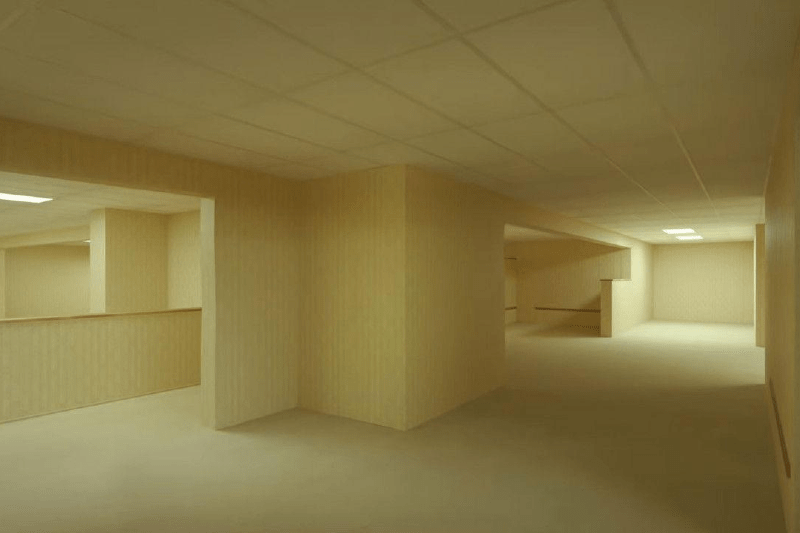


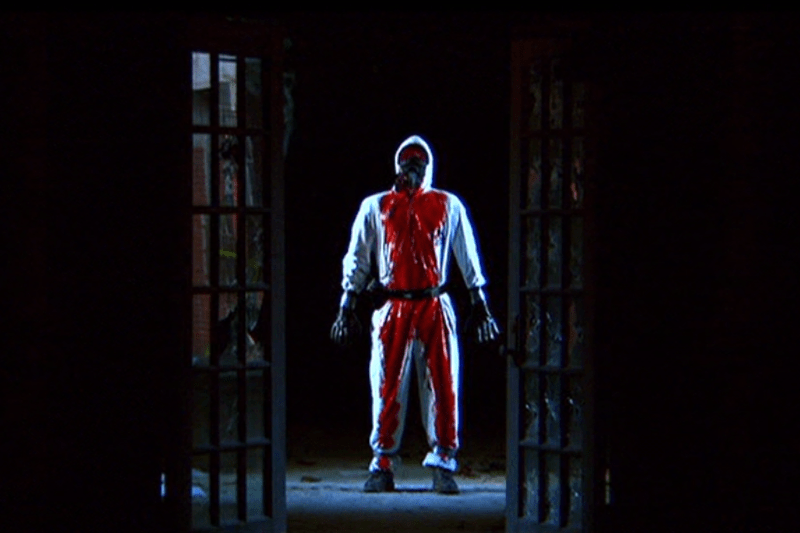
Horror tends to live in the margins, the in-between places that beg to be ignored. There’s an inherent uneasiness to be found in these transitional spaces. A yet-to-be-realized terror born from simply not knowing what comes next – anything, or nothing, could be around that corner. With the recent mainstream success of Backrooms, “liminal horror” has reached a fever pitch; and while it can feel like this subgenre materialized from nowhere, exploring these spaces is far from new. One of the finest entries is Brad Anderson’s Session 9, a low-fi meditation on memory, control, and grief.
Session 9 follows a crew of five men — Gordon (Peter Mullan), Phil (David Caruso), Mike (Stephen Gevedon), Hank (Josh Lucas), and Jeff (Brendan Sexton III) – as they hustle to clean asbestos from the decaying Danvers State Hospital. Strapped for cash and desperate for the job, new dad (and stressed-out boss) Gordon bids low and makes big promises, putting pressure on his crew to get the job done in an unrealistic timeframe. But when they report for work on Monday morning, the men immediately get distracted, quietly getting lost in their own hardships and in their own corners of the massive asylum.
Like a cursed monkey paw slowly closing its fingers, the old hospital has something to offer each crew member. Gambler Hank’s greed is stoked by the appearance of some old silver coins, while law school dropout and history buff Mike happens upon a cache of old audio-taped therapy sessions. And despite getting exactly what he wanted – the gig that would get his life back on track – Gordon is increasingly agitated, acting erratically and pulling away from his team. Everything seems to be going their way, yet upon entering the abandoned asylum, the small group quickly begins to fall apart.
While Danvers is a sprawling eight-wing behemoth, the crew’s work only involves a small portion of the property. But even so, that proves to be more than enough space to disappear into. Long, repetitive halls give way to spiraling metal stairs that only dive deeper into the building’s bowels. Peeling paint and crumbling brick surround them on all sides, the rooms identical in their decay.
Increasingly distracted by the audio tapes, Mike sneaks away to listen more often than he seems to work. The recordings and files tell the story of a patient named Mary, thought to be struggling with dissociative identity disorder, as she tries to recall the details of a tragic, life-defining event. Mary’s voice and personality changes as Mike secretly delves deeper into the mystery. Coincidently, and in tandem with Mike’s discoveries, Gordon’s actions become even stranger and more unpredictable, the most eerie being his seemingly unconnected pull toward the long-dead Mary’s grave marker – number 444. Stranger still, when Hank decides to break into the asylum after hours to collect the silver he found in the basement, he’s overtaken by an unseen assailant.
Hank doesn’t show up the next day, and the rest of the crew is understandably pissed off by his flakiness. But even as they panic and stress over the scale of the job still in front of them, they continue to get distracted – by themselves, each other, and the building itself. The days pass, but they all blend together, the sun seeming to always hang in the same spot. The endless task is daunting, and the remaining men become more harried and aggressive. This is especially true of Gordon, who tries to explain away his increasingly alarming behavior on a fight with his wife, telling Phil he’d been kicked out of the house for slapping her.
But that’s only half the story. As Mike gets to the end of his tapes, finally reaching the ninth and final session, the truth about the asylum – and Gordon – are revealed through Mary’s admissions. After constant goading from her doctor, Mary finally recalls her family tragedy, and the formally dormant personality called Simon takes control. As Simon’s eerie voice recounts the accident that led to Mary suddenly slaughtering her whole family, it’s recognizable as the same voice that’s been calling out to Gordon from the hospital’s shadowed rooms. It turns out, both Gordon and Mary were haunted by the same dangerous emptiness. With Mary’s secret revealed, Gordon’s actions are laid bare. He didn’t just strike his wife – he killed her. And he’s been living in the company van, wandering the hospital halls, pasting pictures of his newborn in Mary’s old room – number 444. He then proceeds to murder his entire crew.
At the end of session nine tape, Simon says he “lives in the weak and the wounded,” and that certainly describes tired old Gordon.The pressures of his new family and failing business became too much to bear, and an already weak man shattered under the weight of it. The hospital’s dark, repetitious halls offered something he so desperately needed – quiet and space. But instead of finding peace, he got trapped in his isolation, the hospital sucking him in and ultimately spitting him out, a shell of who he once was. Ultimately, Gordon’s inability to see what was coming broke him. The abandoned asylum, with its empty rooms full of the past, were enough to push a desperate man over the edge.
Session 9’s embrace of liminal spaces also manages to be something of a blueprint. The subgenre, known for its unsettling re-appropriation of the mundane, thrives in this very real location. Its run-down tunnels and hallways are transitional spaces, transporting the unaware not just to other locations, but other states of being. While the sheer size of the structure – the number of vacant rooms – adds to its surreal footprint. Danvers State, in all its decay, feels dreamlike and familiar, but also a little wrong. A little too big. A little uncanny. It’s no wonder the men each found something of their own to explore within its walls.
Liminal horror certainly isn’t new, and the spaces it explores aren’t always physical. Sometimes they’re states of being. In Session 9, Gordon and his crew are men who live in the margins – the in-between spaces. It makes them vulnerable, allowing the asylum to close in on them easily. Like their seemingly empty lives, the empty hallways of Danvers State Hospital are terrifying both because of their emptiness, and because of the unspoken promise they won’t stay that way. Session 9 forces us to consider which option is worse.