




Spend enough time online and eventually your feed will serve you the tale of Brittany Coppersmith-Whitfield. As the story goes, the 32-year-old woman was arrested for sending her ex-boyfriend 1,847 orders of exactly one lemon on delivery apps. It’s all fake, of course – there is no Brittany Coppersmith-Whitfield and no documented cases of DoorDash "psychological warfare” – but the fact that people believe it speaks to the millennial malaise that makes a film like Russell Goldman’s Sender possible.
Julia (Britt Lower) is not quite ready to admit that she’s an addict. Once the life of the office party, Julia has since lost her job due to her drinking and spends her afternoons hiding in the kitchens during her local AA meetings. Even her attempts to find a sponsor are thwarted when Whitney (Rhea Seehorn) rejects her overtures, pushing Julia to work the process on her own even as Julia’s outreach becomes more insistent.
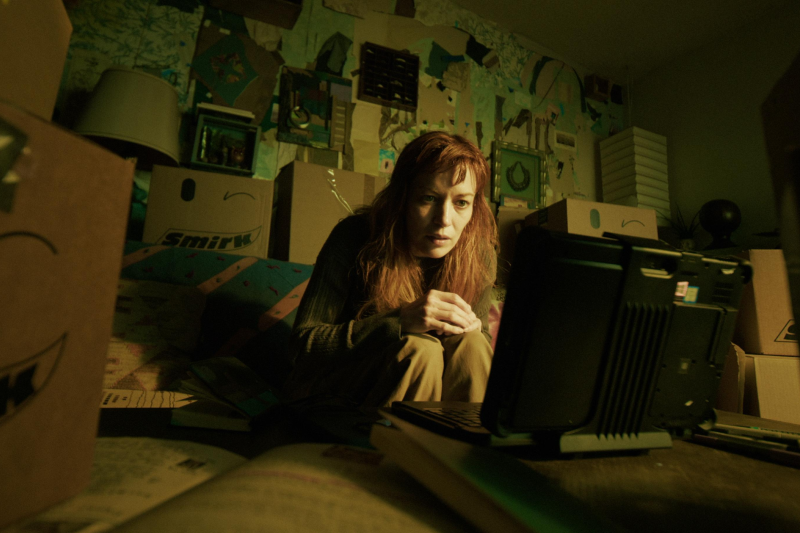
And then she begins receiving boxes she didn’t order from Smirk, an online retailer. At first it’s kind of funny; she strikes up a friendship with Charlie (David Dastmalchian), her Smirk delivery driver, who promises to use his limited influence at the company to get to the bottom of things. It even helps her take her mind off her sister Tatiana (Anna Baryshnikov), who has taken it upon herself to oversee every aspect of Julia’s sobriety.
But as her apartment overflows with packages, her case of mistaken identity begins to take on a sinister pall. The shipments are too specific – too tied to Julia’s half-remembered embarrassments from when she was drinking – to be the result of some anonymous scam. And the more she digs into the possible cause, the more she realizes just how much of her life is out there in the open for the taking. Either way, Julia is determined to solve the mystery behind the Smirk boxes, even if it upends what little self-confidence she has left.
As a first-time feature filmmaker, Goldman occasionally gives into the urge to do too much, especially in the edit of his movie. Much of Sender could be described as a sturdy psychological thriller – one part horror melodrama, one part paranoia thriller – and Goldman and Lower are effective at pulling back the corner of our eCommerce dystopia to find the emptiness underneath. But Goldman also can’t help but indulge a half-dozen narrative devices lifted from 2000s indie cinema. There are soft focus flashbacks and speed ramps galore, and Sender frequently waffles between notes of surreality and a more grounded aesthetic.
These are the kinds of affectations that can sometimes sink a debut feature. But film is a partnership, and whenever Goldman’s flourishes threaten to overtake the movie, his cast is there to put it back on track. Lower serves as the film’s filter, taking in the many disparate ideas and tones and synthesizing it into a consistent emotional core. It’s a strong performance. Julia veers close to absurdity at times, but Lower has a clear sense of who her character should be. She’s not the heroine of some ‘70s espionage thriller; she’s just a tired millennial who is both defined by and rebelling against her addiction.
(Julia’s big solution to being caught in a dystopian nightmare? Tell everyone she’s thinking about going back to school for art. Not even apply to grad school; just tell everyone that she might. There’s not a special bone in the poor woman’s body.)
And then there’s Tatiana. Julia’s sister may present herself as her protector, but she’s just as lost as anyone else, embracing the self-actualization of both Christianity and real estate in an attempt to find meaning. The closer she polices her sister’s behavior – searching her home for hidden stashes of alcohol or digging through her Smirk deliveries for evidence of abuse – the more we understand these actions as displacement. There is love between Julia and Tatiana, but no real affection. This is not a dynamic found often in film, but Baryshnikov and Lower hold those contradictions together with grace.
These performances give Goldman’s script the space it needs to sell its story. You’re not paranoid if everyone really is out to get you, and Sender reminds us that the surveillance state dystopias imagined by men like Alan Pakula and Brian De Palma have come to pass – but only in service of dropshippers and big box retailers. Julia may go to great lengths to solve her mystery, but she will find no cigarette smoking men behind closed doors. The more she digs into her would-be conspiracy, the more she finds people just like her: despondent white collar employees who have been entrusted with only a small fragment of the Smirk kingdom. The most haunting aspect of Sender is how mundane its mystery is; even the film’s red herrings (Tatiana initially suspects review fraud) have both feet planted in the world.
Sender may be a film that feels fragmented to some, but if you are able to lock into its wavelength – connect with Julia’s blend of guilt and resentment as she navigates the gaslighting effect of identity fraud – you may find Goldman’s movie has something poignant to say about the fragility of modern life. Maybe Brittany Coppersmith-Whitfield doesn’t really exist, but most of us spend our days walking along the ledge of our own financial or professional abyss. Sender is here to remind us that the things that break us need not be more dramatic than a few packages too many. [3/5]
Sender plays this week as part of the Chattanooga Film Festival.