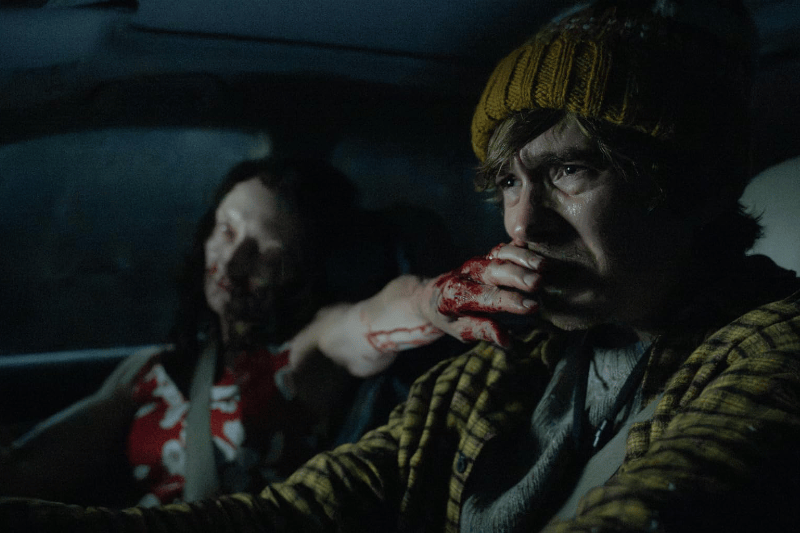





Even under the broadest definitions of the genre, Misper, writer-director Harry Sherriff's debut feature, probably doesn’t deserve a spotlight in a horror publication. This is not a film bothered by the supernatural, and what few scares exist in the film have less to do with their environment than the main character’s struggles to find peace. But if Misper is not a horror movie, then it’s certainly in conversation with ones, and there’s absolutely no chance that a movie this quietly beautiful doesn’t get celebrated for its examination of loss.
It’s been almost two years since Elle (Emily Carey) joined the staff of The Grand, a rundown luxury hotel on the English coastline. In that time, she’s kicked off a gentle flirtation with Leonard (Samuel Blenkin), the kind-but-aimless young man stationed at the front desk. Neither are happy with their jobs, and to make matters worse, The Grand is mere weeks away from possibly being shut down for good. But a job is a job, and Leonard and Elle find their fun on the clock as Leonard works up the nerve to ask her out.
Then Elle disappears. At first, Leonard and the rest of the staff are not too worried; they knew she was contemplating a change, and soon their town makes finding Elle its number one responsibility. But the longer that Elle stays missing, the more Leonard begins to retrace his steps, reflecting on the days leading up to her appearance and struggling with the guilt and uncertainty this introspection kicks up.
It also doesn't help that the more attention Elle’s disappearance gets, the less she's seen as a real person by the community. Leonard bites his teeth as friends share empty platitudes; he reluctantly flips through newspaper articles that work to sensationalize her loss and reduce her to a concept. But each small step Leonard takes towards recovery – such as chatting with the understaffed and overworked local crisis hotline – makes it harder for him to make peace with himself. Leonard is haunted, and there no easy answers for this kind of ghost.
Setting the stage for the story is The Grand, the once-elegant hotel where Leonard and Elle both work. The Grand could easily take on the role of a cursed place in Misper; it certainly features enough darkened basements and waterlogged landscapes to earn its in-movie comparisons to the Overlook Hotel. But Sherriff and cinematographer Bart Bazaz – also making his feature film debut – are more interested in framing The Grand as a dead end for its inhabitants. The staff do their best to brighten up the margins, but the hotel is outdated in ways no handyman or receptionist could hope to fix. It’s a liminal space, a bland stopover for those unable to ask for more from life.
“I feel like I’m living in a horror movie,” Leonard tells his counselor at one point. He’s not, at least not in any way audiences would recognize it. While there are touches of horror present throughout Misper – a few nightmares, an uncomfortable encounter with a rabid true crime fan – the film sits confidently between black humor and drama. But if Sherriff’s story does not exist within the genre, it does exist outside it, enveloping horror’s tropes with a universal story of loss. This is the guilt and sadness that affects all those fortunate to survive a tragedy. These are the feelings every dead teenager’s community must confront head on.
There’s a version of Misper that is gratingly preachy, one that undercuts the gentleness of its message with repeated appeals to media exploitation. Sherriff and co-writer Laurence Tratalos certainly could have sensationalized their message, sketching out “True crime is bad!” in bold letters big enough to see in space. But Misper is not a film about us – it’s a film about its characters, who are forced to relive their final days before Elle’s disappearance with the thought that they might have done something different. It’s a ghost story for the living, for those who wander empty halls unable to move forward from the worst moment of their lives.
That makes Misper another notable example of an emerging trend in genre cinema: movies that step beyond trauma to capture the broken healing process of their characters. For better or worse, Leonard tries to unpack his feelings around Elle’s disappearance. He’s smart enough to know that he never got to know the real Elle, that his feelings about her are as much about the death of possibility as anything else. But Leonard cannot shake the profound brokenness he carries with him every day, and Misper unpacks his healing (or lack thereof) through his small everyday actions. Blenkin gives the role everything he’s got, and for much of its runtime, the film strikes a heartbreaking balance of hope and hopelessness.
In its best moments, Misper calls to mind Limbo, Ben Sharrock’s Scottish feature about a group of Syrian refugees trapped in a legal grey area as they wait to become naturalized citizens. That film also used real-world horrors as a jumping off point to explore ideas both complex and haunting. And while Misper may clock in at a brisk 74 minutes, Sherriff’s film never fails to leave a lasting impression. It’s an astounding debut for all involved, and a perfect antidote for the dehumanization that too often clogs up our feeds. [4/5]
Misper is playing at the Chattanooga Film Festival.