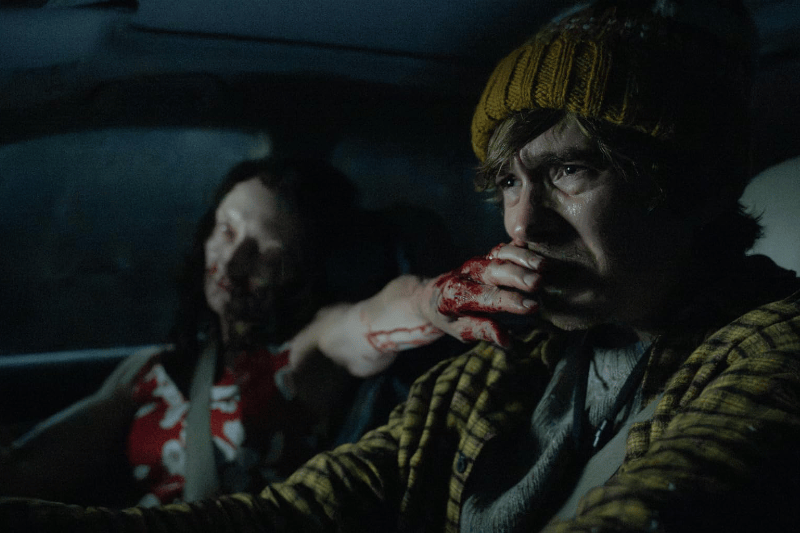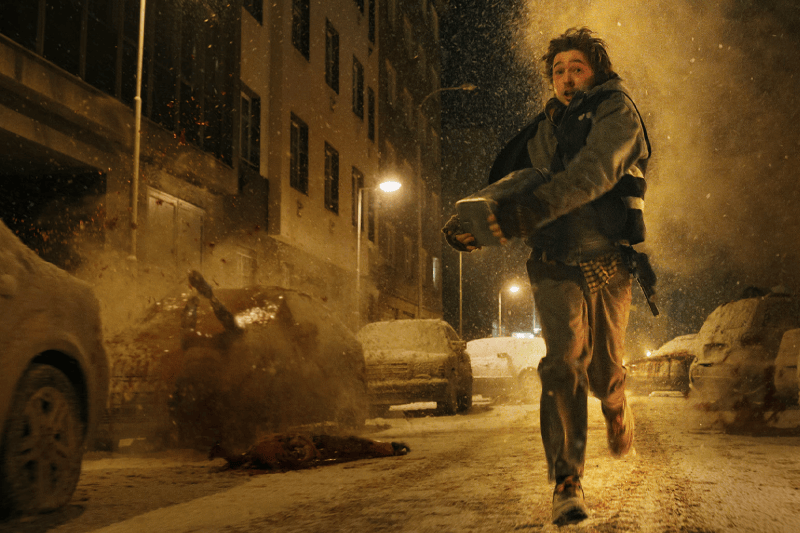




Are you a fan of that scene from Jordan Peele’s Nope, where a domesticated chimpanzee wreaked havoc on a movie set? Well, have I got great news for you! This weekend marks the release of Primate, the latest feature from writer-director Johannes Roberts (Resident Evil: Welcome To Racoon City), which basically turns that sequence into a feature-length narrative. But while many creature features are little more than a gimmick, Primate earns its stripes by blending impressive costume design and slasher tropes to create something uniquely gnarly.
It’s been a year since the death of her mother, and college student Lucy (Johnny Sequoyah) is finally headed home to reconcile with her family. She’s been hurting, and that has caused her to keep her distance from her sister Erin (Gia Hunter) and her father Adam (the ever-wonderful Troy Kotsur, whose deafness is given real weight as a narrative device in the film). It has also caused her to lose touch with Ben, her late mother’s chimpanzee who has become a minor celebrity for his language development, as well as a genuine member of their family.
So when Adam discovers a dead mongoose in Ben’s cage, nobody is initially worried. There aren’t any cases of rabies in Hawaii, and both Lucy and Erin are careful enough around Ben that Adam feels comfortable leaving the girls – and several of their friends – at home alone during his travels. But Ben is sick and getting sicker, and suddenly begins acting hostile towards Lucy and Erin – eventually launching into a full-fledged attack.
Once Ben becomes dangerous, the movie shifts into high gear. Lucy and her friends are able to escape Ben by hiding in the pool, but Erin is wounded in the process, slowly bleeding out into the water. The rest of the movie takes on a series of short dashes from pool to the house – to look for a phone, or a set of car keys, or some kind of a weapon. But each time someone climbs out of the pool, Ben is waiting, and it isn’t long before the survivors begin to dwindle.
Like a lot of modern horror, Primate uses trauma as a shorthand for character development. Lucy and her sister have recently lost their mother, and the two struggle to reconcile after processing that loss in different ways. One would think, then, that Primate might use Ben as connective tissue between the girls. Ben represents their closest tie to their late mother; if the film wants to engage earnestly with its own trauma-informed storytelling, then there must be some screen time dedicated to the collapse of their remaining family unit.
And then Ben rips off someone’s jawbone and uses it to pantomime talking.
This unstable dichotomy – well-meaning characters dealing with family trauma versus the Grand Guignol of death – has become increasingly common in horror. And sometimes, or even often, this uneasy marriage of empathy and slaughter can make for frustrating cinema. But what saves Primate from falling into this trap is its apathy towards its own backstory. Once Ben succumbs to his illness, the relationships between the characters cease to matter – the actors step into their archetypal roles as slasher victims, and Primate shifts its focus to well-crafted violence.
That may sound like faint praise. It’s not. Primate is a small miracle of costume design and performance, turning a silly concept into a genuinely tense game of cat and mouse (or, well, monkey and human). Actor and movement specialist Miguel Torres Umba creates a real, tangible terror in Ben, giving this character a frightening physicality. Umba also manages a shocking amount of emotion through the layers of prosthetics – once Ben turns, he is delighted by his own cruelty, and that only heightens the effect of Primate’s monkey slasher premise.
For all its modern sheen, Primate also seems to carry a healthy respect for the Italian giallo in its back pocket. From the breathy, Goblin-esque soundtrack, to the frequent layering of fabric over Ben’s face, Roberts evokes the playful and grotesque set pieces often found in the films of Dario Argento or Mario Bava. What Primate might lack in cohesive stakes, it more than makes up for in production design, and audiences who walk in expecting a 90-minute punchline will be surprised at how stylish the entire affair manages to be.
There will always be a place in the genre for low-concept, high-execution horror. Whether you’re a veteran of animal attack movies, or just drawn in by the ubiquitous bumpers, you’ll probably have a good time with Primate. Maybe Ben deserved better – certainly Lucy’s friends did. But by the time the chimpanzee is ripping people’s faces off with his bare hand, it’s not that kind of movie anymore. Primate is the perfect mashup of slasher and creature feature, and a welcome addition to both genre canons. [3.5/5]