
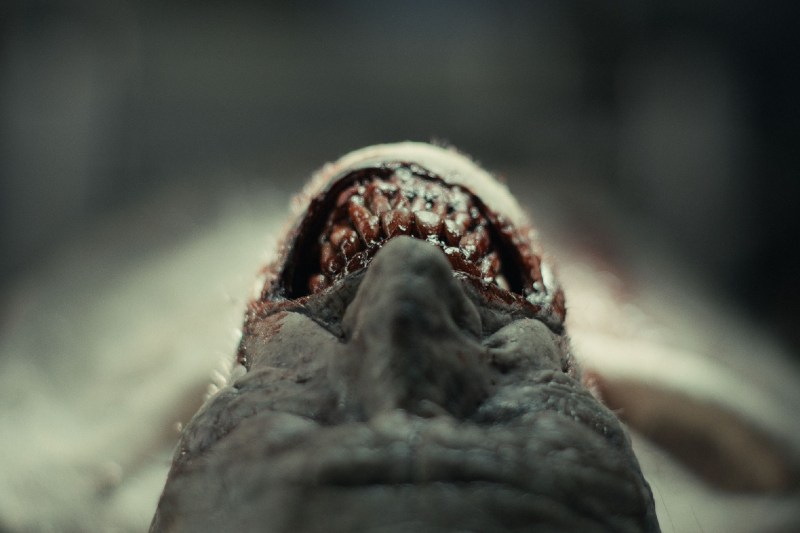
This interview contains spoilers for Jordan Downey's The Cycle.
Few filmmakers have done as much with as little as Jordan Downey. Alongside longtime collaborator and cinematographer Kevin Stewart, Downey has spent his career balancing the fantastical against the pragmatic, often leaning heavily into practical effects to craft ambitious horror films that transcend their modest budgets. While best known in many circles for his over-the-top ThanksKilling “trilogy,” it was The Head Hunter that proved Downey’s skill at grounded, feature-length storytelling. Now the director is back with The Cycle, a slow burn creature feature that has become an immediate hit in the weeks before Halloween.
For those of us raised on a steady diet of police procedurals, there are many elements of The Cycle that feel comfortably familiar: strong women, strange murders, small towns. But one of the things that immediately sets the film apart from an ocean of Silence of the Lambs imitators is the performance of Deborah Ann Woll. Woll might be best known for her work on television, but she’s no stranger to horror – in fact, the first impression Downey had of his future star was from a smaller horror franchise. “I remember watching Escape Room and seeing her in that and being like, wow, who is this character? Who is this actress?” Downey recalled.
Stay in touch
Sign up for our free newsletter
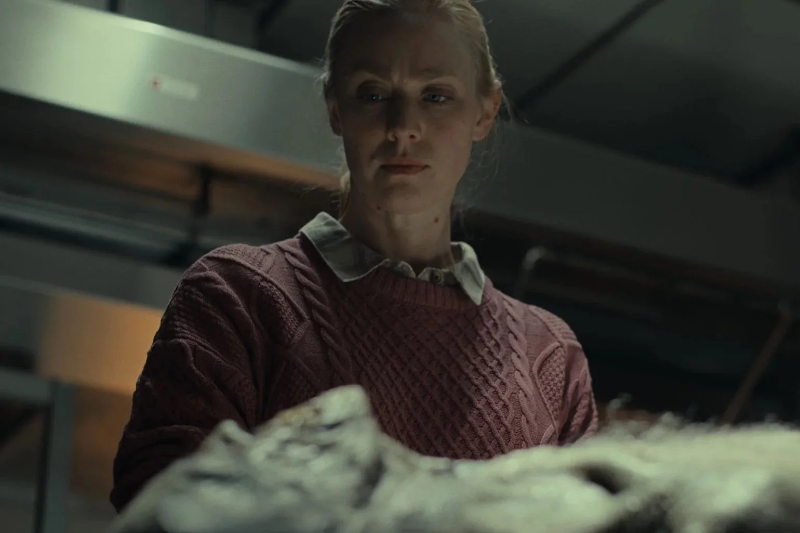
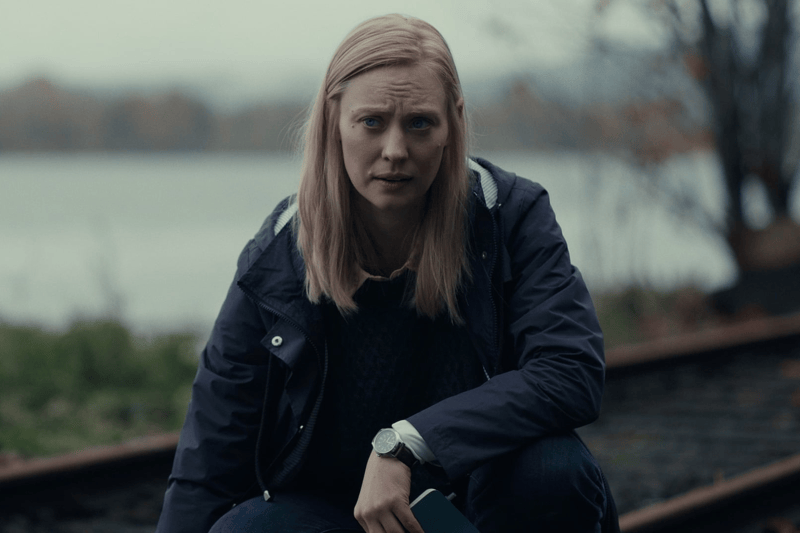
In The Cycle, Woll plays Meg Garland, a forensic pathologist whose obsession with death ties back to the loss of her father. It can be a challenge to present a character whose specialization makes them smarter than both screenwriter and performer; there’s no shortage of films that fail to live up to their own suggested field of expertise. To combat this, both Downey and Woll spent time with Scottish forensic anthropologist Sue Black, whose writing helped form the basis for the script and Woll’s performance. Together, they crafted a character who audiences instinctively trust is always the smartest person in the room.
“Not only do we have the dates and the logic of a police investigation to deal with – while hiding a big secret and big mystery – we also have this fringe, niche aspect of the science industry with body farms and studies of decomposition,” Downey explained. “And the movie was so grounded and it was taking itself so serious that we had to get that right or you would've just checked out.”
But the script is just one of the elements that helps ground the movie. The Cycle was also filmed in the noted cinematic hotbed of Astoria, which straddles the Columbia River between Washington and Oregon. For a town of just 10,000 people, Astoria has a surprisingly robust film history, having served as a principal location for ‘80s films like The Goonies and Short Circuit. More recently, Astoria was home to Ryan Spindell’s The Mortuary Collection, which is how it ended up on Downey and Stewart’s radar.
During preproduction, Downey and his collaborator set aside time to scout much of the Pacific Northwest, knowing how much the location would matter to the story. “Kevin Stewart and I started in Northern California and drove the whole coast,” Downey said. “We were looking for the perfect town.” About halfway through their trip, the director had the idea to call Spindell, who demanded that the duo cancel their road trip and make a beeline towards his former location. “He was like, ‘Guys, just stop driving and stopping in towns. Just go straight to Astoria.’”
Astoria looks incredible on camera – the peninsula’s rolling forests provide a stark contrast to the open water, and much of what The Cycle shows on film speaks to the dreary reality of many Pacific Northwest towns. But Astoria was also a city familiar with the film industry, featuring both the retailers and hospitality needed to support a film shoot. “The first day we were there, we went into the little restaurant in the hotel and they were like, ‘Oh yeah, you should go meet this guy,’” Downey recalled. “Then we went and met that guy and he said, "Oh, great. Come and meet this guy.’ And every time we asked for something, the door just opened.”
That kind of support matters on any production, especially one that is constantly trying to turn its limitations into strengths. According to Downey, the idea to make a werewolf movie was planted during development on a television adaptation of The Head Hunter, where a throwaway conversation about set dressing sparked an entirely new creature design. Downey joked that it would’ve been a nice easter egg to refresh one of the fake heads on the title character’s wall of trophies. “Oh, it would've been cool if we would've swapped the werewolf head back to a human head in the background,” Downey recalled telling Stewart. “And he was like, yeah, but it would've been even cooler if, a month later, we swapped it back to a wolf head."
The more Downey and Stewart thought about it, the more they realized they had something rare: a fresh take on a classic movie monster. “I can't think of even a schlocky, straight-to-video ‘80s zombie-werewolf movie,” Downey added. “It had never really been done at any sort of level.” And to bring an undead werewolf to life on the screen, special effects supervisor Patrick Magee leaned into the creature’s emaciated look, keeping most of actor Trevor Newlin’s lower body exposed with only simple prosthetics. “Imagine if [the werewolf in] Dog Soldiers was running on all fours, it probably would look somewhat similar to the monster in The Cycle.”
And if the idea of a slow-burn procedural and a zombie werewolf monster movie seem at odds, well, welcome to the world of Jordan Downey. The two sides of Downey as a filmmaker – that less is more, and that more is more – are balanced beautifully in the film, which builds slowly and methodically before descending into creature feature excess. “Great monster movies should have great stories behind them,” Downey explained, “and just nonstop carnage doesn't feel the weight of that.” When reflecting on his body of work, Downey believes that each of his features is a product of their environment, with even something as over-the-top as Stork having its basis in real-world consideration. “Stork was a little bit like, ‘Oh my God, this is V/H/S. We've been cooped up in the pandemic for three years. Let's just go make something that's batshit insane."
And for as much as The Cycle has earned accolades for its creature design and its ambitious production design, when asked to share his biggest takeaway from production, Downey pointed to his pride in their collaborative environment. “It's something that Kevin and I have been very particular about on our movies over the years: that everybody has a voice, everybody is a contributor,” Downey added. Whatever fears the two might have had about this approach scaling up was proven unfounded. “We're in an industry that's filled with so many difficult people and so much rejection. I just want to try to be the opposite of that."
The Cycle is now available to stream on Shudder.