
Given the significant impact that Stranger Things has had on popular culture, it’s strange to think that anything released by the Duffer Brothers could be overlooked. But Stranger Things was not the first project of the Netflix golden boys. That distinction belongs to Hidden, their debut feature that received a limited theatrical release a year before Stranger Things premiered. And while there are many reasons to enjoy Hidden – from its excellent cast to its top-notch production design – its most enduring legacy might be as an example of a twist ending done right.
Because in a franchise landscape where connected universes and franchise lore are synonymous with good storytelling, a clunky twist ending feels like a breath of fresh air.
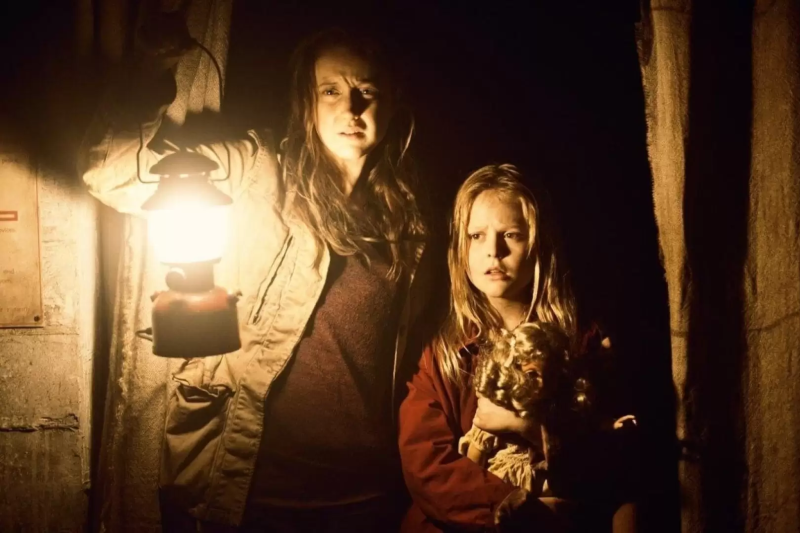
Something terrible has happened to the world, and Ray (Alexander Skarsgård) and Claire (Andrea Riseborough) have built a new life for their daughter Zoe (Emily Alyn Lind) underground. What was once an abandoned fallout shelter is now their home, and the family has spent months surviving on canned food and the shelter’s archaic water filtration system. And while life is hard, Ray and Claire do their best to keep Zoe engaged, teaching her a few classroom basics while also drilling into her the new rules that keep their family safe.
Stay in touch
Sign up for our free newsletter
Because they’re not alone. On the surface, unseen creatures – “breathers” – stalk the ruins of their small town, searching for survivors. Zoe lives in constant fear of these unknown entities, retreating to the safety of her imagination and holding onto fragments of her picturesque small town before things were shot to hell. But nothing lasts forever, and soon Ray and Claire are forced to venture aboveground to ensure the safety of the shelter – putting them at risk of becoming the breathers’ latest victim.
Those who approach Hidden as little more than errata for Stranger Things should leave satisfied. The film offers a fascinating first look at the ideas that the Duffer Brothers would spend their next decade developing. Even in their debut feature, the directors show a knack for threading the needle between science fiction and horror, making Hidden a worthwhile companion piece to Dan Trachtenberg’s 10 Cloverfield Lane (which would hit theaters a mere seven months later). The Duffer Brothers even make board games a major point in their debut feature, establishing tabletop games as an unlikely throughline of their career.
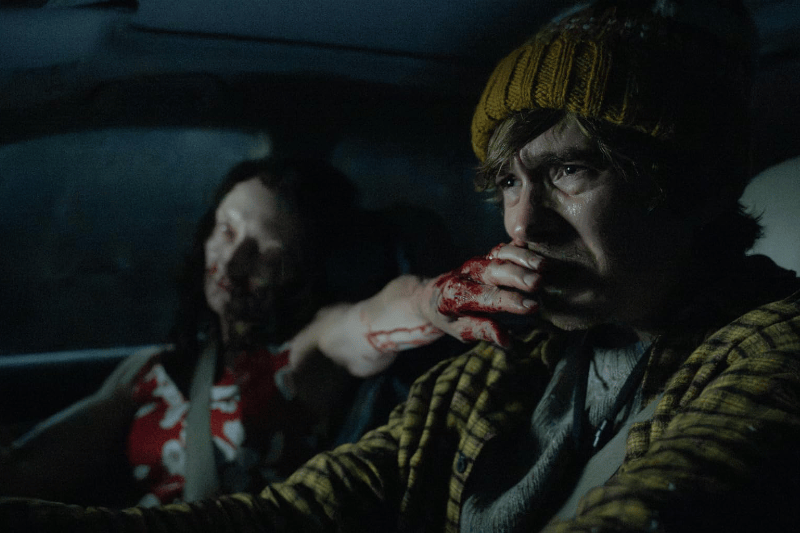
But Hidden is a film built around a big third-act reveal. As the danger escalates, we learn that our heroes are actually the monsters. Ray, Claire, and Zoe were infected by an airborne pathogen, and all three are forced to flee their makeshift home when they are invaded by (human) soldiers in respirators. After repeatedly telling their daughter to stay in control, Ray and Claire allow themselves to transform, tearing through the soldiers as their veins flood with a black toxin. In its final minutes, our chamber piece has become a James Cameron feature.
And as the family fights for their survival, we flash back to military fighters bombing Ray and Claire’s city and soldiers massacring families at government checkpoints. Because Emily St. John Mandel had it right: to the monsters, we’re the monsters.
Hidden is, of course, structured to make this twist work. It’s why Ray and Zoe call the creature outside of the bunker “breathers” – a phrase that is notable only for its ambiguity. It’s also why the family’s backstory is revealed in drips and drabs, or why the rules they claim to follow are referenced intermittently and without consequence (until the very end). Nine times out of ten, a film like Hidden is an exercise in plot over characters, with audiences all-too-aware of the narrative gears grinding away in the background.
But the biggest surprise for Hidden is how well the twist lands emotionally. It works because the Duffer Brothers confidently wield their fragments of a story, never trying to overexplain either the nature of the pandemic or the world as it stands beyond the town’s borders. It also works because the film trusts its cast to do most of the heavy lifting. Skarsgård and Riseborough are given thin characters on paper, but they meet the material more than halfway, filling in the cracks between plot points. So much of Hidden depends on us buying the family dynamic, and the film’s leads – particularly Riseborough – secure our buy-in with strong performances.
All of which paves the way for the twist to work. It’s not exactly breaking new ground in the realm of science fiction to suggest that the government does not have our best interests at heart. But what may have seemed cartoonish even a decade ago – the idea of military strikes on a sleepy midwest community – are now bolstered by years of federal occupation of major cities and never-ending footage of genocide and death at a grand scale. For all its contrivances, Hidden taps into the anger and fear that is a hallmark of the best works of speculative fiction. It’d make a wonderful companion piece to Frank Darabont’s adaptation of The Mist.
A good twist ending doesn’t need to present bulletproof logic; it just needs to earn our willingness to have the rug pulled out from us. Hidden reminds us that it’s sometimes fun to give ourselves over to the gears – as long as a movie gets enough right to justify the price of admission. It may not be the property its directors are known for, but it’s certainly proof that their big ideas are not limited to the world of Stranger Things. If they have more movies like this in them, perhaps there can be life after Hawkins for the Duffer Brothers after all.